%20%20--%3E%0A%3Csvg%20version%3D%221.1%22%20id%3D%22Layer_1%22%20xmlns%3D%22http%3A%2F%2Fwww.w3.org%2F2000%2Fsvg%22%20xmlns%3Axlink%3D%22http%3A%2F%2Fwww.w3.org%2F1999%2Fxlink%22%20x%3D%220px%22%20y%3D%220px%22%0A%09%20viewBox%3D%220%200%20684.6%2068.1%22%20style%3D%22enable-background%3Anew%200%200%20684.6%2068.1%3B%22%20xml%3Aspace%3D%22preserve%22%3E%0A%3Cg%3E%0A%09%3Cpath%20d%3D%22M444.1%2C29.3h-17.4v14.5h17.4V29.3z%20M36.4%2C68.1l29.3-50.8V0H50.4L32.9%2C36.8L15.5%2C0H0v68.1h16.7V45.8l12.4%2C22.3H36.4z%0A%09%09%20M49.1%2C68.1h16.6V23.4L49.1%2C52.1V68.1z%20M76.6%2C68.1h45V53.8H93.3V41.6h21V27.1h-21V14.8h28.3V0.1h-45V68.1z%20M175.6%2C68.1h17.3v-68%0A%09%09h-16.5v40.3L150%2C0.1h-17.6v68h16.7V27.7L175.6%2C68.1z%20M235.8%2C14.8h15.4V0.1h-47.4v14.7H219v53.2h16.8V14.8z%20M290.3%2C45.9h-17.1%0A%09%09l7.5-15.6h2L290.3%2C45.9z%20M298.7%2C68.1h18l-32.2-68h-5.7l-32%2C68h18l3.3-7.1h27.1L298.7%2C68.1z%20M325.2%2C68.1h46.2V53.8h-29.6V0.1h-16.7%0A%09%09V68.1z%20M423.7%2C14.8h27.2V0.1H407v68h16.7V14.8z%20M462%2C68.1h46.2V53.8h-29.6V0.1H462V68.1z%20M564.8%2C34.1c0%2C10.7-7.2%2C19.2-18.5%2C19.2%0A%09%09c-11.4%2C0-18.5-8.5-18.5-19.2s7.1-19.2%2C18.5-19.2C557.6%2C14.9%2C564.8%2C23.4%2C564.8%2C34.1%20M580.6%2C34.1c0-19-14.2-34-34.3-34%0A%09%09c-20.2%2C0-34.3%2C15-34.3%2C34c0%2C19%2C14.1%2C34%2C34.3%2C34C566.4%2C68.1%2C580.6%2C53.1%2C580.6%2C34.1%20M604.8%2C20.5c0-4.1%2C3.3-6.2%2C6.7-6.2%0A%09%09c4.4%2C0%2C6.6%2C3%2C6.6%2C6.6h14.7C631.8%2C9.1%2C625.1%2C0.1%2C611%2C0.1c-12%2C0-21.7%2C9.3-21.7%2C20.6c0%2C10.9%2C5.9%2C15.9%2C16.7%2C19.8%0A%09%09c5.2%2C1.8%2C11.5%2C3.2%2C11.5%2C8c0%2C3.3-2.4%2C5.5-6.4%2C5.5c-3.6%2C0-6.6-3-6.6-6.7h-15.2c0%2C11.5%2C7.9%2C20.8%2C21.8%2C20.8c12%2C0%2C21.6-9.3%2C21.6-20.6%0A%09%09c0-10-5.3-16.4-16.7-19.8C610.6%2C26.1%2C604.8%2C25.3%2C604.8%2C20.5%20M670%2C20.9h14.7C683.8%2C9.1%2C677.1%2C0.1%2C663%2C0.1c-12%2C0-21.7%2C9.3-21.7%2C20.6%0A%09%09c0%2C10.9%2C5.9%2C15.9%2C16.7%2C19.8c5.2%2C1.8%2C11.5%2C3.2%2C11.5%2C8c0%2C3.3-2.4%2C5.5-6.4%2C5.5c-3.6%2C0-6.6-3-6.6-6.7h-15.2c0%2C11.5%2C7.9%2C20.8%2C21.8%2C20.8%0A%09%09c12%2C0%2C21.6-9.3%2C21.6-20.6c0-10-5.3-16.4-16.7-19.8c-5.4-1.6-11.3-2.4-11.3-7.2c0-4.1%2C3.3-6.2%2C6.7-6.2C667.7%2C14.4%2C670%2C17.3%2C670%2C20.9%0A%09%09%22%2F%3E%0A%3C%2Fg%3E%0A%3C%2Fsvg%3E%0A)

“One out of every 21 Black American males will be murdered in their lifetime. Most will die at the hands of another Black male.”
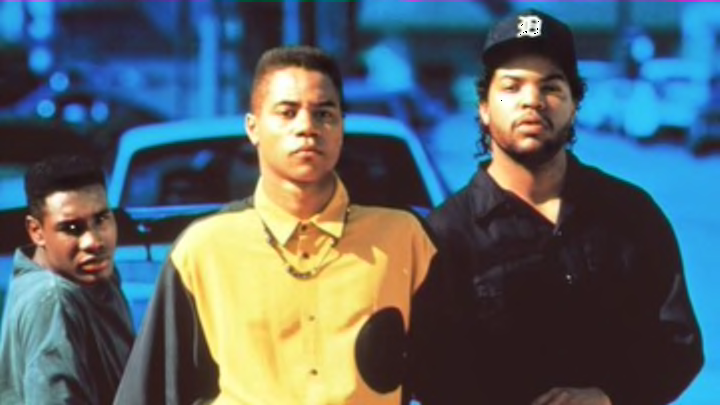
That’s the statistic that set the tone for audiences as they entered theaters 25 years ago today to see Boyz N the Hood, a film that took its title and one of its leads (Ice Cube) from the rap group N.W.A.
The film marked the feature directorial debut of John Singleton, who was just 23 years old at the time. With its raw story of life in South Central Los Angeles, the film shook the country and shocked the world with its unrelenting depictions of violence and poverty.
The cast of unknowns went on to become a who’s who of talented actors and actresses, and the film is now considered an undisputed classic that changed how stories were told on film, not just for “Black movies,” but for all of cinema.
1. THE STORY IS LARGELY AUTOBIOGRAPHICAL.
When writing the script, John Singleton (then 21 years old) pulled from his own life growing up in Los Angeles. The main character, Tre (played by Cuba Gooding Jr.), is sent to live with his father across town while his mother works and goes to school, which is the situation Singleton found himself in as a child. He has stated in interviews and in DVD commentary that several elements from his real life made it into the script and film, from the blocks where he used to live to the elementary school that he attended and even a few specific events, including the time his father shot at a fleeing burglar. “It was kind of cathartic," Singleton said. "This movie was my way of kind of getting out of the ghetto as a person.”
2. SINGLETON WAS OFFERED $100,000 TO WALK AWAY.
While pitching the script to different companies, Singleton refused to give out copies unless someone was willing to make a deal where he would get to direct the film, even though he had no prior feature film directing experience. Columbia Pictures expressed interest in buying the film, and during a meeting Singleton was offered $100,000 to let a more experienced director take over the project. “I said, ‘Well, we’ll have to end this meeting right now, because I’m doing this movie. This is the movie I was born to make,'" Singleton recalled in the documentary Friendly Fire: Making of an Urban Legend. Columbia’s response was to give Singleton the green light and $6 million to make the movie.
3. IT WAS TECHNICALLY A BIGGER HIT THAN TERMINATOR 2.
In the fight for box office dollars, there was no competition between Terminator 2: Judgment Day and Boyz N the Hood in 1991. The former raked in nearly $205 million domestically, while Singleton’s film only made around $58 million. But numbers can be deceiving: Terminator 2 cost $102 million to make, or just under half of what it pulled in, while Boyz N the Hood only cost $6 million to make. According to Ebony, Terminator 2 had a much wider theatrical release, but Boyz N the Hood made more money per screen.
4. THE FILM OWES A LOT TO SPIKE LEE.
Singleton was inspired and motivated by Spike Lee, though not in an entirely positive way. He says that hiring Black people to work in front of and behind the camera was one thing he took from the director, but his motivation to make films like Boyz N the Hood came after Lee—who he looked up to—didn't hire him as a production assistant on Do the Right Thing. “When they didn’t I was like ‘F*ck Spike Lee, I’ma do my own sh*t. I’ma make a West Coast movie,'" Singleton said during a panel discussion at the 2011 LA Film Fest. It was after seeing Lee’s Oscar-nominated film in theaters that Singleton began writing his own script.
5. ICE CUBE AND LAURENCE FISHBURNE WERE SHOO-INS.
Many of the film's lead actors are respected actors today with impressive resumés but, like Singleton, many of them were unknown at the time, which was by design. In Friendly Fire, Singleton said that he told casting director Jaki Brown that he “didn’t want to see anybody that you’ve seen in any other movie before.” Laurence Fishburne had had several small roles in films like The Color Purple and A Nightmare on Elm Street 3: Dream Warriors, but his real break was playing a supporting character for nine episodes of Pee Wee’s Playhouse, where a 19-year-old Singleton worked as a security guard. He told Fishburne then that he would someday write a movie and have him in it.
Singleton also knew that he wanted Ice Cube to play the role of Doughboy, but he had to work for two years to convince the rapper to take the job. “I was really engulfed in my music,” Cube said in 2011, “but I had seen Ice-T do New Jack City and Kid ‘n Play do House Party, so I was like, ‘OK, it’s time for us rappers to make movies now’ ... but I hadn't read the script or memorized the lines, so I kept f*cking up. It was just terrible.”
Despite a bad audition, Singleton was in Ice Cube’s corner because he believed in the rapper’s ability (and because it worked with his vision). He told him to go read the script and to come back the next day, but warned him that he had to be good or they would find someone else. Cube realized that the movie was really “about how we grew up,” and was able to successfully tap into the character.
6. STACEY DASH WAS ALMOST TRE’S LOVE INTEREST.
The role of Brandi launched Nia Long’s career as an actress, but she wasn’t the only person to read for the part. Brent Rollins—a college friend of Singleton’s and the designer of the film’s logo—wrote about how he was there when Stacey Dash auditioned. A few years later she became well known as Dionne in the very different LA-centric film, Clueless.
Cuba Gooding Jr. said that there were other familiar faces there at the time of his audition, including Shemar Moore and the Wayans Brothers, but he did not say which roles they were reading for.
7. THE FILM INCLUDES HOMAGES TO STAND BY ME.
In an interview with Jog Road Productions, producer Steve Nicolaides revealed that Singleton wanted him to produce the film because of his previous work on one of Singleton’s favorite films, Rob Reiner's Stand By Me. Reiner picked up on Singleton’s choice to mimic a fade out effect on one of the main characters at the end of the film. “It was an homage,” Nicolaides told Reiner during the making of A Few Good Men. “I mean, the fat kid wears a striped shirt in it, too.”
Another element that the films share is the invitation to “see a dead body.” Singleton says that he hadn’t actually seen a dead body growing up.
8. THERE’S A SLIGHT DISS AIMED AT N.W.A.
By the time he was cast in the film, Ice Cube had already left the rap group N.W.A because of issues with royalties and his interest in pursuing a solo career. There was some bad blood between Cube and his former bandmates, so Singleton decided to throw in an inside joke, which he revealed in the DVD commentary. He had the rapper bring old Eazy-E shirts to the set, and in one scene a crack addict wearing one of the shirts runs by and tries to steal the character Dooky’s gold chain, but he is caught and swiftly punished.
The real Eazy-E would later tell SPIN magazine that Boyz N the Hood reminded him of a “Monday after school special with cussin’,” adding that Ice Cube was only being used to sell the film.
9. SHOOTING ON LOCATION HAD SOME OF THE CREW ON EDGE.
All of Boyz N the Hood was shot in the houses and on the streets of South Central. Even though Singleton and others in the cast and crew called the neighborhood home, filming there was a bit more unpredictable than filming on closed sets. “The set was about 10 blocks from my house,” Nia Long said. “I could have walked, except that probably wouldn’t have been the safest thing to do.” Cuba Gooding Jr. said that there were fistfights and threats everyday, and Singleton said in his commentary that after an altercation, there was a threat of gun violence by local gang members. The film crew requested that a van be parked behind them while filming so that if a drive-by did happen, they would be safe.
Singleton used the dangers of the neighborhood to ramp up tensions. In one scene, the characters are supposed to react to rapid gunfire on a crowded Crenshaw Boulevard, but Singleton did not tell them when it was coming. The only direction he gave was for Ice Cube to drive off in his 1964 Chevy Impala when he heard the shots. In his commentary, the director said that genuine reactions to the noise are what created the perfect chaos on screen, with characters running, ducking, and falling over each other.
10. EVERYONE COULD FEEL THE EMOTION IN THE SCRIPT.
In his commentary, Singleton admitted that he cried while writing Doughboy’s monologue for the end of the film, which includes the iconic line “either they don’t know, don’t show, or don’t care about what’s going on in the ‘hood.” Cube has said that the scenes where he is supposed to cry were the hardest for him because he was used to burying his feelings. Gooding was not as composed. He once punched a hole in a wall during an emotional day and the crew had him sign it. In the DVD documentary, Fishburne said that he cried while reading the script, and Long said that after filming the scene where Tre punches at the air in frustration, she left the set to cry outside.
11. THE MOST ICONIC SCENE WAS THE MOST DIFFICULT FOR MORRIS CHESTNUT.
Morris Chestnut said that his first film role is the one that he is recognized most often for, and it’s all thanks to the alley scene. Dropping your milk and scratch-offs and trying to run from a shotgun blast (in slow motion) sounds difficult enough, but Chestnut said in an interview with The Huffington Post that the technical side of the scene required more focus than the acting. “The stunt coordinator was telling me ‘Listen, when you run, make sure you keep your head up.’ Because if you put you head down, those [squibs] could explode in your face ... so I was very nervous.”
12. IT BOOSTED SALES FOR MALT LIQUOR BRANDS.
Hip hop has a long and complicated history with the alcohol and tobacco industries. Showing characters drinking 40-ounce bottles on screen, though a reflection of real life, caused sales to skyrocket. A Los Angeles-based distributor of St. Ides was forced to ration his stock following the film’s release because of increased demand.
Ice Cube was a spokesperson for the malt liquor until the brand came under pressure for controversial ad campaigns in late 1991. According to David J. Leonard in the book Icons of Hip Hop: An Encyclopedia of the Movement, Music, and Culture, Volume 2, Cube had become “increasingly uncomfortable” with promoting the beverage, and having Doughboy pour it out at the end of the film was “not just about the character paying respect to the dead but reflects Cube’s own desire to wash his hands of his relationship with Ides and the advertising industry’s exploitation of hip hop.”
13. BOYZ N THE HOOD TOOK THE CANNES FILM FESTIVAL BY STORM.
Those involved in the making of the film knew how special it was, but they were not sure how it would translate culturally (and with subtitles) to the Cannes audience, which was far removed from the streets of South Central Los Angeles. According to Nicolaides, the response was overwhelming. “Lights go down, the movie plays out, the movie’s over, lights go up ... I look up and people are hanging off the balcony trying to get John’s attention to say how great it was. The whole Mount Rushmore of Black artists and filmmakers is on their feet ... Roger Ebert is crying his eyes out. It was one of those.”
The Los Angeles Times reported that the standing ovation lasted for 20 minutes.
14. LIFE IMITATED ART IMITATING LIFE WHEN THE FILM OPENED IN THEATERS.
As was the case with New Jack City four months prior, Boyz N the Hood was met with some backlash after some incidents of violence at theaters were reported as being related to the film. In the DVD documentary, Singleton said that he left one showing just before alleged gang violence erupted (he personally witnessed a potential conflict between Crips and Bloods and tried to have security intervene), but he maintained that neither he nor the film were to blame because it was a reflection of real life.
According to a Newsweek article published that summer, around 21 theaters pulled the film after “opening-night violence left two moviegoers dead and more than 30 injured.” A story in JET magazine cited film critic Roger Ebert as saying that actor Mickey Rourke blamed “malicious directors like Spike Lee and John Singleton” for instigating the Los Angeles riots. “It wasn't the film,” Singleton told Newsweek. “It was the fact that a whole generation [of black men] doesn't respect themselves, which makes it easier for them to shoot each other. This is a generation of kids who don't have father figures. They're looking for their manhood, and they get a gun. The more of those people that get together, the higher the potential for violence.”
The director went on to call the pulling of the film from theaters “artistic racism,” adding that fights happen all the time, but “because my film has a black cast, it gets pulled—just like that.”
15. THE PRESIDENT RESPECTED THE FILM’S REALISM.
In a 1993 interview with Rolling Stone, then-President Bill Clinton was asked about comments that the attorney general had made about violence on television, and whether or not the government was granted the power by the Constitution to restrict what viewers saw. In his response, Clinton referenced Boyz N the Hood and shared his thoughts on the film:
“I do believe that the people who are making the films and the shows are just reflecting what they think the consumers want and what they think is really going on in society. I understand that. But because that is what is in fact going on in society, there's a synergy that is destructive ... There is a synergy, and I don't think we can avoid that fact. The best thing is for us to ask ourselves what can be done to break the link without muzzling the creators. For example, I watched Boyz n the Hood very carefully. While it was very violent, it had no romance about the violence. That is a movie I would've wanted a lot of elementary-age kids in the inner city to see, because there was no romance. It was a mean, ugly, sad, heartbreaking tale of basically good kids who wanted to have a decent life who had it taken away from them.”
16. IT HAS BEEN RECOGNIZED BY THE LIBRARY OF CONGRESS.
In 2002, Boyz N the Hood was entered into the National Film Registry of the Library of Congress, a program established in 1989 as a way to preserve films deemed important enough to be kept for future generations. Only 25 films are chosen each year. “I was honored ... that means that it’s one of those things that goes far beyond my life,” Singleton told BlackTree TV. Stephanie Allain, who was an executive at Columbia Pictures at the time, added that they had the opportunity to present the film to the Congressional Black Caucus. “That was very special ... to have lawmakers watching the movie, that’s the stuff of dreams. That means you’re doing something really, really well.”