YouTube
YouTube

18 Catchy Facts About Footloose

YouTube
YouTube

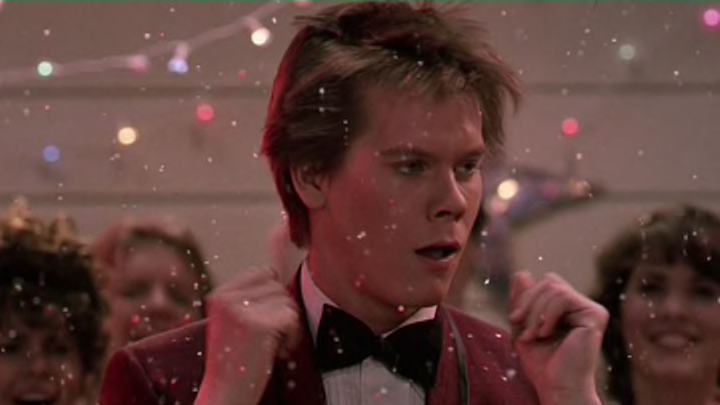
Ren McCormack (Kevin Bacon) moves to a small town that has banned dancing and rock music, thanks to a minister (John Lithgow) who has suffered a family tragedy, in Footloose. When Ren’s need to dance influences his peers, the 1984 drama film had its conflict. Here are some facts about the movie that’ll help you cut loose.

1. IT WAS BASED ON ELMORE CITY, OKLAHOMA.

Elmore City had forbidden public dancing by law since its founding. In January of 1979, the local high schoolers asked that the rules be changed so that they could have a prom, to the anger of the reverend from the United Pentecostal Church. The kids won and got to dance on prom night. Dean Pitchford (lyricist for Fame songs "Red Light", "Fame", and "I Sing The Body Electric") read about all of it and visited the town. Pitchford had his screenplay after 22 drafts.

2. TOM CRUISE ALMOST PLAYED REN.

The producers wanted Tom Cruise, but he had a scheduling conflict with All the Right Moves (1983). Rob Lowe auditioned and blew out his ACL. "I have post-traumatic stress with anything having to do with Footloose," Lowe said later, while recalling a party where Kenny Loggins asked him to do a karaoke duet of the theme song. "I was like, ‘I won’t do anything with that damn movie, but I’ll do Danger Zone from Top Gun.'”

3. CHRISTOPHER ATKINS HAD THE LEAD, THEN LOST IT.

The Blue Lagoon star Christopher Atkins claimed he was cast as Ren. Unfortunately for him, he was under the influence of drugs and/or alcohol when he met with the producers and the director before taking a vacation where he was planning to have more “fun.” When he found out he lost the role, Atkins had a breakdown and was hospitalized.

4. MADONNA AUDITIONED FOR ARIEL.

Had she gotten the part, it would have been her first feature film role. That didn’t come until 1985, in A Certain Sacrifice. Lori Singer got to play Ariel Moore instead.

5. SARAH JESSICA PARKER WASN’T THE FIRST CHOICE FOR RUSTY.

Pitchford had written the role with Tracy Nelson, Parker’s co-star on the short-lived but cult favorite TV show Square Pegs (1982-1983), in mind. After successfully auditioning, director Herbert Ross’ wife noted that she didn’t fit into the movie.

6. PARKER INITIALLY TURNED THE ROLE DOWN.

The future Sex and the City star passed after being told she had to cut and dye her hair red, something she did not want to do after her hair was finally growing out after playing Annie on Broadway. A couple of days into production, the studio changed their mind and let the actress keep her locks.

7. MICHAEL CIMINO WAS THE DIRECTOR FOR FOUR MONTHS.

Michael Cimino, the Oscar-winning director of The Deer Hunter and Heaven’s Gate, kept asking for grandiose set-ups and making more and more demands—like requesting $250,000 to rewrite the script, and to make the film darker. Paramount Pictures feared Cimino was going to lose them a ton of money after Heaven’s Gate bankrupted United Artists, and so they let him go. Herbert Ross (director of The Goodbye Girl and Steel Magnolias) took over.

8. THE FILM'S ORIGINAL TITLE WAS CHEEK TO CHEEK.

Cheek to Cheek was a placeholder, and Pitchford filled pages of yellow legal pad paper with any ideas he could think of to come up with a better title. On the second day of doing this, he wrote down "footloose and fancy free," and then "footloose." Pitchford liked it because "footloose" is “one of those interesting words that looks good on paper—you see it scrawled across a billboard, and it sells itself."

9. BACON WENT UNDERCOVER AS A HIGH SCHOOL STUDENT.

Only the principal and guidance counselor at Payson Utah High School knew the true identity of one “Ren McCormack,” a transfer student from Philadelphia. The then 24-year-old Bacon was terrified, and was treated the way his character ended up being treated in the movie. He only lasted two to three hours.

10. BACON DIDN’T REALIZE WHAT HE WAS GETTING HIMSELF INTO.

The script, according to Bacon, “didn’t really indicate anything” and led him to believe he didn’t need a choreographer. He spent three weeks of dance training with Lynne Taylor-Corbett. Bacon also worked on his gymnastics, and “worked the skin off his hands.”

11. BACON WASN’T HAPPY ABOUT NEEDING STUNT DOUBLES.

Gymnast Chuck Gaylord, brother of Olympic gymnast Mitch Gaylord, did the complicated gymnastics. Peter Tramm, who had appeared in Staying Alive, was Bacon’s dance double. In 2011, Bacon joked that he “was furious ... It's like a starting pitcher getting taken out of a game—no one wants to be told they can't get the guy out." Bacon balked at the studio’s request to not tell the media he had used any doubles.

12. BACON’S JEANS WERE MADE EXTRA TIGHT ON PURPOSE.

"I remember having these pants on that were unbelievably tight already, but weren't quite tight enough for some of the shots,” Bacon recalled on the DVD commentary. “They would take them and pin them from behind so they were really skintight. It wasn't so much about sexiness as it was that line to make the [dance] move look powerful."

13. CHRIS PENN CAME IN WITH NO DANCE SKILLS.

Taylor-Corbett got Chris Penn to dance after she equated it to wrestling, something Penn loved and used to do. Bacon said the best dance scene in the movie was his character Ren teaching Penn’s character, Willard, to dance. Originally, the two danced to the Karla Bonoff song “Somebody’s Eyes”—Ross said it didn’t work with the scene. Pitchford and Tom Snow wrote a more uplifting song instead around the line “Let’s hear it for the boy.”

14. JOHN LITHGOW DECEIVED A MINISTER.

John Lithgow needed help channeling his character of Reverend Shaw Moore, so he found an Assembly of God minister in the Yellow Pages. Lithgow told him he was lonely on location shooting in Utah, and asked if he could talk to him about Jesus. Lithgow recounted to The Huffington Post that it was an “incredibly valuable thing to do. I did feel like a total hypocrite, a snake in the grass, but without that—this man was extremely kind and very persuasive. That's what I needed to play that part and deliver those sermons.”

15. BACON NEEDED HALF A VALIUM FOR THE TOWN COUNCIL SCENE.

Bacon's real fear of public speaking resulted in hives appearing all over his ribs. He was given half a Valium to calm himself down for the scene when Ren pleads with the Bomont town council to bring dancing back.

16. KENNY LOGGINS AND DEAN PITCHFORD WROTE THE TITLE TRACK ON PAINKILLERS.

Loggins had broken a rib at a show, and Pitchford had strep throat and a fever of 101 when the two met in Lake Tahoe, Nevada. Because Loggins was soon flying to Asia, Pitchford hid the fact he was sick from Loggins by spraying his throat with Chloraseptic and taking decongestants so the two could get their songwriting done and appease Paramount. "I think it was two or three days we kept up this charade with him showing up on his painkillers and me on my painkillers, and us getting the gist of the song," Pitchford recalled.

17. THE PROM SCENE HAD TO BE RE-SHOT.

Ross wanted the final scene to play out in slow motion, until the film was screened and it made the end drag. When it was re-shot, new dance styles like popping-and-locking were added. It cost $250,000 to do the reshoot six weeks before the film’s opening. Producers went to L.A. dance clubs on New Year’s Eve looking for talent.

18. BACON PAYS DJS TO NOT PLAY FOOTLOOSE.

While he loves the song, Bacon doesn’t like it when it’s played at parties he’s attending, because when it is played, he’s expected to perform “like a trained monkey.”

nextArticle.image_alt|e
John P. Johnson, HBO
10 Killer Facts About Barry
John P. Johnson, HBO

When Bill Hader told TV dynamo Alec Berg (Seinfeld, Silicon Valley) that he wanted to make a show about a hitman, Berg thought the genre was glib and played out, but they got to work. When Hader told HBO he wanted to play the hitman, they responded with, "You?"

Yes, him. Hader has delivered another indelible comic character into our lives through Barry. This time it’s someone who kills for a living but seeks an escape from all the low-drama, high-violence world in the high-drama, low-violence world of acting class. The show is an incredible feat of tonal balance that’s equally comfortable going for humor and heartache; it's something truly fresh and original, even by prestige TV standards.

Here are 10 facts about the humane hitman show, which just earned six Emmy nominations, including nods for Outstanding Comedy Series and Outstanding Lead Actor in a Comedy Series for Hader.

1. BILL HADER PITCHED IT AS TAXI DRIVER MEETS WAITING FOR GUFFMAN.

Barry Berkman isn’t exactly as terrifyingly manic as Taxi Driver's Travis Bickle, but the classic Robert De Niro character was one of their launch points for the show as they sold it to HBO. Hader asked them to consider Barry as the story of Bickle or William Munny from Unforgiven meeting the awkwardly uproarious local acting troupe in Waiting for Guffman. After bringing it to life, the comparison is spot-on. Barry’s job is intense and filled with blood, and his hobby is filled with the pathetic dreamers of his acting class.

2. THEY ALSO DREW INSPIRATION FROM FARGO and BOOGIE NIGHTS.

Barry’s tone is a tough magic trick to pull off. Few TV shows and movies have so flawlessly bounced between morbid gut punches and silly comedic escapades. While the Coen brothers are legendary for diving between tones, particularly with the bleakly comic Fargo, and Paul Thomas Anderson’s '70s porn narrative Boogie Nights is a bit more abstract and dreamlike in its shifts between the two drama masks, Hader and Berg looked to those two movies to understand how to make us drop our jaws right before (or after) making us laugh.

3. THEY COMPLETELY RESHOT EVERY SCENE WITH FUCHES IN THE PILOT.

Stephen Root and Bill Hader star in 'Barry'
Jordin Althaus, HBO

Barry’s exploitative father figure Fuches (Stephen Root) was originally an antagonistic bruiser who yelled at Barry a lot. HBO suggested they should instead be friends, which clicked with Hader, and they reshot all of Fuches’s scenes to play off the new dynamic. They also rewrote and reshot Barry’s monologue to Gene Cousineau (Henry Winkler) about his life as a killer, so Hader’s speech was shot almost a year after Winkler’s reaction shots to it.

4. BARRY’S ANXIETY ABOUT KILLING PEOPLE MIRRORS HADER’S FEARS ABOUT SATURDAY NIGHT LIVE.

The key to Barry is that he’s very good at something that’s bad for him. The same went for Hader, who experienced intense anguish and stage fright. “I had very bad anxiety about being onstage. I also didn’t like the live aspect of the show,” Hader told Vulture. Not exactly the best situation for a guy on a show with “Live” right there in the title. He was one of the best on SNL, but it was hurting him.

5. BUT SNL PREPARED HADER TO MAKE HIS OWN SHOW WITHOUT HIM KNOWING IT.

After shooting Barry, it dawned on Hader that his time at the sketch comedy mainstay had quietly prepared him for every aspect of production. He’d already learned how to collaborate with costume designers, set designers, directors of photography, and other crew members by doing it every week for eight seasons on Saturday Night Live. “You don’t realize how much you’ve learned until you’re done,” Hader said.

6. HADER’S TIME ON INSIDE OUT AFFECTED HOW HE APPROACHED THE STORY.

Tyler Jacob Moore, Bill Hader, and Rightor Doyle in 'Barry'
John P. Johnson, HBO

The flipside to Barry’s unhealthy skillset is his escapist desire to dive deep into a world he doesn’t have much talent for. That’s an existential collision that brings about massive change, so naturally Hader turned to a movie about the personified emotions in a little girl’s head for inspiration. Hader voiced Fear for Pixar's Inside Out, and Pete Docter’s original pitch—how his daughter transformed from a joyful child to a sullen teenager—really stuck with Hader, who approached writing Barry not by starting from the joke, but by considering each character’s emotion.

7. THEY DON’T WANT TO GLAMORIZE VIOLENCE.

“[Berg and I] like action movies, but people getting murdered is terrible,” Hader told GQ. That’s a core ethos for the way they shoot and edit the necessary violence for a story about a guy who kills for a living. Those scenes don’t feature slow motion or swelling scores or intense looks. They’re usually hauntingly matter-of-fact, leaving audiences with an uneasy, gruesome feeling, and even the villains of the show are depicted as human beings with children’s toys scattered across their living rooms while the only character who loves violence (Dale Pavinski’s cocaine-fueled Taylor) is portrayed as a profoundly idiotic buffoon.

8. BARRY’S NOT THE ONLY CHARACTER LIVING A DOUBLE LIFE.

One of the show’s slyest tricks is making us focus on whether one of Barry’s lives will ruin the other while quietly filling the cast with characters who all have double lives. Sarah Goldberg, who plays wannabe actor Sally, wisely pointed this out: “Everybody in the show is pretty desperate for something, desperate for change, desperate to get out of their situation, and everyone’s living these double lives.” Gene is king while teaching his acting class, but a schmo crossing his fingers at a hopeless commercial audition. Sally and the other students live partially in a dream world of stardom but then return to their real jobs. Detective Moss (Paula Newsome) is a principled cop willing to sacrifice it for happiness with Gene.

9. ONE SCENE ACTUALLY DISTURBED THE GUY WHO CRAFTED GAME OF THRONES'S RED WEDDING.

Game of Thrones co-creator David Benioff is friends with Berg, so they screened the episode “Make the Unsafe Choice” for him. The episode includes Barry slowly strangling a man who gasps and flops and says, “You don’t have to do this,” in Spanish. Barry says, “Yeah, I guess not,” then kills him anyway. The scene’s intensity caused Benioff to respond with a single curse word because he found it so dark. When you’ve shocked the guy who wrote the Red Wedding episode of Game of Thrones, you know you’ve got something.

10. SARAH GOLDBERG INITIALLY THOUGHT THE SEXUAL HARASSMENT SCENE WAS A BIT TOO OVER-THE-TOP.

Sarah Goldberg and Henry Winkler in 'Barry'
John P. Johnson, HBO

Sally’s dream of stardom is spoiled in a late episode when the manager who has taken her on provisionally tells her that he wants to have sex with her. It’s a slimy moment, and Sally is taken so off-guard that she ends up apologizing to him for making the situation awkward. “When I first read it, I thought, ‘Is it a little much that he says he wants to f**k her?’” Goldberg recalled. “And now it’s like, 'Jesus, we could’ve gone further. That’s the PG-13 version compared to the horrible stories we’ve all read.'"

nextArticle.image_alt|e
Hulton Archive/Getty Images
8 Facts About John D. Rockefeller
Hulton Archive/Getty Images

There’s rich, there’s wealthy, and then there’s John D. Rockefeller. Considered by many to be the most financially-prosperous individual in modern history with an estimated $900,000,000 bank balance (unadjusted for inflation) in the early 1910s, Rockefeller (1839-1937) made his massive fortune by dominating the oil industry. While Rockefeller was prone to controversy—he was accused of being a monopoly in the fuel business—he was also a generous philanthropist, donating over a half-billion dollars in his lifetime (and that's also unadjusted for inflation). Take a look at some things you might not have known about the legendary tycoon.

1. HIS DAD PRETENDED TO BE A DOCTOR.

While his son would go on to want for nothing in life, William Avery Rockefeller was not a man of resources. The one thing he could depend on was a somewhat diabolical gift for conning others. Before his son was born, William spent time as an itinerant, going from place to place pretending to be deaf and soliciting free meals. (Eliza, the daughter of one such target, became his wife and John’s mother.) In other towns, he would hand out sheets referring to himself as “doctor” and pretend to have found a “cure” for cancer. The elder Rockefeller also insisted that his mistress, Nancy, live in the same house as his family, where she bore him two children. William Rockefeller would continue peddling “medicines,” sometimes under the pseudonym of William Levingston—and when he died in 1906, that was the name on his tombstone.

2. HE CELEBRATED HIS OWN PERSONAL HOLIDAY.

More important to Rockefeller than his own birthday was what he called “Job Day.” The future oil magnate was born and raised in upstate New York and took on his first real job at the age of 16 for a grain and coal supplier/shipper after his family relocated to Cleveland, Ohio. The date he started—September 26, 1855—was when Rockefeller believed he got his official start in business. As an adult, he celebrated the day every year.

3. HE DID EVERYTHING HE COULD TO DOMINATE THE OIL INDUSTRY.

A portrait of John D. Rockefeller
Hulton Archive/Getty Images

Rockefeller’s wealth was a consequence of his obsession with owning the oil industry. He struck deals with railroads to ship his goods cheaply, bought out smaller companies, and helped usher in the concept of a monopoly in modern times. Smaller businesses were faced with a choice: be consumed or attempt to compete with his massive corporation. His buying spree was referred to as the “Cleveland Massacre.” By 1882, his company, Standard Oil, owned or controlled 90 percent of all refineries in the United States. “Competition is a sin,” he was allegedly quoted as saying.

4. HE HIRED A STAND-IN SOLDIER TO SERVE FOR HIM IN THE CIVIL WAR.

John D. Rockefeller stands in a field
Hulton Archive/Getty Images

Due to be drafted to serve the Union in the Civil War in 1863, the 23-year-old Rockefeller did what many men of means had done: He paid for someone to serve in his place. This practice was allowed by the U.S. government, which granted draftees the ability to offer up a substitute. No record exists of who the man who took Rockefeller’s spot was. His brother, Frank, chose to serve at age 16, telling a recruiting sergeant he was 18. Despite being wounded in battle, he survived.

5. HE HELPED REDUCE HOOKWORM IN THE UNITED STATES.

With his fortune, Rockefeller pursued a number of philanthropic efforts in his lifetime. In 1910, that funding led directly to the widespread treatment of a mostly-forgotten illness: hookworm. The larvae enter the soles of the feet and travel the bloodstream to the lungs before settling in the intestine, where sufferers can experience stunted growth, anemia, and exhaustion. More than 40 percent of the population in southern states had hookworm infection in the early 20th century. The Rockefeller Sanitary Commission for the Eradication of Hookworm Disease used Rockefeller’s $1 million donation to map out high-risk areas and made a concentrated effort to cure infected residents with Epsom salts and thymol while educating the public on the need for improved sanitation systems.

While it was thought for decades that hookworm had been essentially eradicated in the United States, a recent study found that it still occurs in impoverished areas of Alabama and possibly other regions of the deep south—but not with the severity of the early 20th century.

6. HE LIKED HANDING OUT DIMES TO STRANGERS.

John D. Rockefeller hands a coin to a child
Hulton Archive/Getty Images

In the early 1900s, Rockefeller often traveled by ferry from his home in Tarrytown across the Hudson River and into Nyack, New York. When his ferry docked, he would typically be greeted by children. Rockefeller came prepared, handing out dimes to his welcoming party. Rockefeller was also known to hand out coins to adults. He reportedly did this in part to instill habits of savings and thrift in people. Many of them hung on to their famous “Rockefeller dimes” as a keepsake.

7. SOMEONE PLANNED TO BLOW HIM UP.

At the turn of the century, bomb threats and detonations were often used to make a point against capitalism by radicals looking to upend the system; business barons like J.P. Morgan and Rockefeller were targeted. In the case of Rockefeller, it’s been proposed that he was targeted for his family’s role in the Ludlow Massacre in Colorado, when several striking miners—and even children—were killed during fighting with the Colorado National Guard and mine guards. Fortunately for Rockefeller, his would-be assassins never made it to his Tarrytown home: On July 4, 1914, an explosion went off in a Harlem tenement, killing several anarchists who had been storing dynamite at the location. Their plan had been to leave it at Rockefeller’s doorstep.

8. MARK TWAIN PLAYED A ROLE IN STANDARD OIL'S DOWNFALL.

A portrait of writer Mark Twain
Hulton Archive/Getty Images

In 1900, Ida Tarbell, the daughter of one of Rockefeller's business rivals, decided to even the score with Rockefeller by writing an extensive 19-part expose on his questionable business practices for McClure’s magazine. A key source was Henry Rogers, who worked for Rockefeller as an executive for Standard Oil for roughly 25 years. Rogers heard of the series Tarbell was working on and felt Standard Oil should be involved, asking his friend Mark Twain to inquire with McClure’s. Twain eventually asked, “Would Miss Tarbell see Mr. Rogers?” and a meeting was arranged. Rogers later grew upset when he saw Tarbell’s articles, but it was too late. Her reporting led to a 1911 Supreme Court ruling that broke up Standard Oil for good, mincing it into a series of companies that later became known as Chevron, ExxonMobil, and others. Tarbell didn’t spare words about her vendetta or potential lack of objectivity. In the copy, she referred to the slim Rockefeller as a “living mummy.”

SECTIONS

arrow
LIVE SMARTER
More from mental floss studios