%20%20--%3E%0A%3Csvg%20version%3D%221.1%22%20id%3D%22Layer_1%22%20xmlns%3D%22http%3A%2F%2Fwww.w3.org%2F2000%2Fsvg%22%20xmlns%3Axlink%3D%22http%3A%2F%2Fwww.w3.org%2F1999%2Fxlink%22%20x%3D%220px%22%20y%3D%220px%22%0A%09%20viewBox%3D%220%200%20684.6%2068.1%22%20style%3D%22enable-background%3Anew%200%200%20684.6%2068.1%3B%22%20xml%3Aspace%3D%22preserve%22%3E%0A%3Cg%3E%0A%09%3Cpath%20d%3D%22M444.1%2C29.3h-17.4v14.5h17.4V29.3z%20M36.4%2C68.1l29.3-50.8V0H50.4L32.9%2C36.8L15.5%2C0H0v68.1h16.7V45.8l12.4%2C22.3H36.4z%0A%09%09%20M49.1%2C68.1h16.6V23.4L49.1%2C52.1V68.1z%20M76.6%2C68.1h45V53.8H93.3V41.6h21V27.1h-21V14.8h28.3V0.1h-45V68.1z%20M175.6%2C68.1h17.3v-68%0A%09%09h-16.5v40.3L150%2C0.1h-17.6v68h16.7V27.7L175.6%2C68.1z%20M235.8%2C14.8h15.4V0.1h-47.4v14.7H219v53.2h16.8V14.8z%20M290.3%2C45.9h-17.1%0A%09%09l7.5-15.6h2L290.3%2C45.9z%20M298.7%2C68.1h18l-32.2-68h-5.7l-32%2C68h18l3.3-7.1h27.1L298.7%2C68.1z%20M325.2%2C68.1h46.2V53.8h-29.6V0.1h-16.7%0A%09%09V68.1z%20M423.7%2C14.8h27.2V0.1H407v68h16.7V14.8z%20M462%2C68.1h46.2V53.8h-29.6V0.1H462V68.1z%20M564.8%2C34.1c0%2C10.7-7.2%2C19.2-18.5%2C19.2%0A%09%09c-11.4%2C0-18.5-8.5-18.5-19.2s7.1-19.2%2C18.5-19.2C557.6%2C14.9%2C564.8%2C23.4%2C564.8%2C34.1%20M580.6%2C34.1c0-19-14.2-34-34.3-34%0A%09%09c-20.2%2C0-34.3%2C15-34.3%2C34c0%2C19%2C14.1%2C34%2C34.3%2C34C566.4%2C68.1%2C580.6%2C53.1%2C580.6%2C34.1%20M604.8%2C20.5c0-4.1%2C3.3-6.2%2C6.7-6.2%0A%09%09c4.4%2C0%2C6.6%2C3%2C6.6%2C6.6h14.7C631.8%2C9.1%2C625.1%2C0.1%2C611%2C0.1c-12%2C0-21.7%2C9.3-21.7%2C20.6c0%2C10.9%2C5.9%2C15.9%2C16.7%2C19.8%0A%09%09c5.2%2C1.8%2C11.5%2C3.2%2C11.5%2C8c0%2C3.3-2.4%2C5.5-6.4%2C5.5c-3.6%2C0-6.6-3-6.6-6.7h-15.2c0%2C11.5%2C7.9%2C20.8%2C21.8%2C20.8c12%2C0%2C21.6-9.3%2C21.6-20.6%0A%09%09c0-10-5.3-16.4-16.7-19.8C610.6%2C26.1%2C604.8%2C25.3%2C604.8%2C20.5%20M670%2C20.9h14.7C683.8%2C9.1%2C677.1%2C0.1%2C663%2C0.1c-12%2C0-21.7%2C9.3-21.7%2C20.6%0A%09%09c0%2C10.9%2C5.9%2C15.9%2C16.7%2C19.8c5.2%2C1.8%2C11.5%2C3.2%2C11.5%2C8c0%2C3.3-2.4%2C5.5-6.4%2C5.5c-3.6%2C0-6.6-3-6.6-6.7h-15.2c0%2C11.5%2C7.9%2C20.8%2C21.8%2C20.8%0A%09%09c12%2C0%2C21.6-9.3%2C21.6-20.6c0-10-5.3-16.4-16.7-19.8c-5.4-1.6-11.3-2.4-11.3-7.2c0-4.1%2C3.3-6.2%2C6.7-6.2C667.7%2C14.4%2C670%2C17.3%2C670%2C20.9%0A%09%09%22%2F%3E%0A%3C%2Fg%3E%0A%3C%2Fsvg%3E%0A)

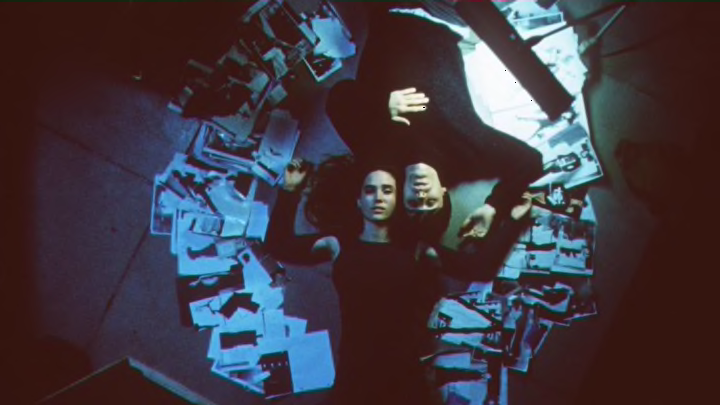
Before The Wrestler and Black Swan, before The Fountain and Noah, there was Requiem for a Dream, the harrowing heroin film that brought Darren Aronofsky to the attention of mainstream moviegoers in 2000. (His first film, Pi, had been an underground hit.) Few who have experienced the film’s tragic stories of addiction have forgotten it, the images seared on our brains forever like the scars on a junkie’s arm. So let’s dive deeper into this turn-of-the-century masterpiece.
1. Darren Aronofsky was a newly minted Hollywood hotshot, yet nobody wanted to make Requiem for a Dream.

Darren Aronofsky’s first movie, Pi, won the Directing Award at Sundance in 1998, and was nominated for the festival’s Grand Jury Prize, earning him some serious attention within the indie world. When Pi also turned out to be a financial success—it cost $60,000 to make; sold to Artisan Entertainment for $1 million; and earned $3.2 million at the box office—Hollywood really sat up and listened. Financiers told the then-29-year-old filmmaker that his next project could be anything he wanted. But when he sent the Requiem for a Dream screenplay around, no one called him back. Turns out when Hollywood says “anything,” they mean “anything that’s commercially marketable.”
2. Darren Aronofsky had a long history with the author of Requiem for a Dream.
The director was in college when he discovered Hubert Selby, Jr.’s 1964 novel Last Exit to Brooklyn, a controversially explicit look at life in one of the city’s neighborhoods. Aronofsky, a Brooklyn native himself, said he became obsessed with the book, and found Selby’s 1978 novel Requiem for a Dream a little later, when he was in film school.
3. Darren Aronofsky and Hubert Selby, Jr. wrote separate screenplay adaptations of Requiem for a Dream that turned out to be remarkably similar.
Selby supported Aronofsky’s desire to turn his book into a movie. Selby had actually begun writing an adaptation himself years earlier, but had lost it. Aronofsky said that when he was about three-quarters finished writing his version, Selby found his own old draft. Comparing them, Aronofsky was surprised to find they were “about 80 percent” the same.
4. Requiem for a Dream’s 20-second cleaning-the-house-on-speed scene came from a 40-minute timelapse.
One of the film’s many trippy visuals is the scene where Sara Goldfarb (Ellen Burstyn), jacked up on diet pills, cleans her apartment in fast motion. Using a timelapse camera and some tricky lighting effects to mimic the changing sunlight, Aronofsky had Ellen Burstyn bustle around while the camera very, very slowly panned across the set. Burstyn moved in a rapid, jerky manner, so it would look even faster when it was sped up. A single take took 40 minutes, and Aronofsky had her do it three times. That fake apartment was clean.
5. Someone got hurt during the scene in Requiem for a Dream where Harry and Tyrone play keep-away with a cop’s gun, who warns them that “someone’s gonna get hurt!”
Indeed, while Jared Leto and Marlon Wayans were tossing the gun back and forth, an errant throw caused the gun to hit Wayans in the head. That’s one of several reasons not to take a cop’s gun, even in a heroin-induced fantasy.
6. Tappy Tibbons wasn’t in the original Requiem for a Dream book.
The charismatic infomercial host on whom Sara Goldfarb is fixated was Aronofsky’s invention. In the novel, Sara has the traditional housewife viewing habits: soap operas and game shows. But Aronofsky worried that showing clips of then-current programs would date the film, irrevocably marking it as a product of the year 2000. He wanted something less specific, something that could theoretically have been on TV anytime in the last few decades.
7. Marion and Harry’s last phone conversation in Requiem for a Dream wasn’t in the book, either.
Aronofsky wanted a way for those two characters to connect in the third act of the movie, when Harry (Jared Leto) has left town for Miami and Marion (Jennifer Connelly) is getting involved in the sex-for-drugs world. (In the book, they simply drop out of each other’s lives.) The director and his actors wrote the scene together through improvisation. For added authenticity, Aronofsky shot both halves of the conversation simultaneously, on adjacent sets, so Leto and Connelly could really be talking to one another.
8. Requiem for a Dream featured real junkies as extras.
If the scene where a fresh shipment of heroin is distributed to a mob of eager junkies in the back of a supermarket seems particularly realistic, it might be because most of those extras were actual junkies.
9. Ellen Burstyn spent four hours a day in the makeup chair for Requiem for a Dream.
That’s how long it took to apply the various prosthetic necks (there were four of them) that helped make the actress look older, heavier, thinner, or unhealthier, depending on the scene. There were also two different fat suits (a 40-pounder and a 20-pounder) and multiple wigs.
10. Darren Aronofsky’s college roommate provided the special effects for Requiem for a Dream.
Aronofsky credits one of his Harvard roommates, an animator named Dan Schrecker, with turning him into a filmmaker. Schrecker’s company, Amoeba Proteus, did the special effects for Requiem for a Dream (there are about 150 of them) and for most of Aronofsky’s subsequent movies, including Black Swan and Noah.
11. Darren Aronofsky says Requiem for a Dream is not a “drug movie,” and has a list of things it is instead.
“I was never interested in making a movie about junkies,” Aronofksy said in a 2000 interview. “I find junkies really boring.” So what is the film? “In a lot of ways, we looked at [it] as a monster movie. The creature was invisible; it lived in their heads. Addiction.” And what else is it? “It’s a punk movie where the audience is a mosh pit of emotion.” And what else? “Ultimately the film is about the lengths people will go to escape their realities, and what happens when you chase after a fantasy.” Anything else? “Mostly, it’s about love. More specifically, it’s about what happens when love goes wrong.”
12. Requiem for a Dream almost had a hip-hop soundtrack.
Like a lot of Jewish kids from Brooklyn in the 1980s, Aronofsky grew up loving hip-hop music. Composer Clint Mansell said Aronofsky originally wanted Requiem for a Dream to have a score consisting of reworked classic hip-hop songs, much the same way his later film Black Swan would use music from Swan Lake. But none of the hip-hop they paired with Requiem had the right feel (and besides, Mansell said hip-hop “was never my strong suit anyway”), so they tried some instrumental pieces Mansell had been working on as samples.
Additional Sources:
Blu-ray features and commentaries