Paramount Pictures
Paramount Pictures

15 Things You Probably Didn’t Know About Braveheart

Paramount Pictures
Paramount Pictures

You remember Mel Gibson’s award-winning performance as William Wallace, but these nuggets about the creation of Braveheart may enrich your repeat viewings.

1. Screenwriter Randall Wallace first had the idea on a vacation to Edinburgh.

He saw statues of William Wallace (no relation) and Robert the Bruce adorning Edinburgh Castle and asked a tour guide who they were. The guide proceeded to tell the screenwriter about their story. Wallace was immediately inspired to write a screenplay about the famed warriors.

2. But Wallace didn’t immediately start his research.

Wallace opted to do specific historical research after he completed his screenplay because he wanted to capture the drama of the story first and input historical details later. Wallace brushes off claims of the movie’s historical inaccuracy by saying that the script is only his dramatic interpretation.

3. Mel Gibson didn’t want a title sequence.

The director opted against including a main title sequence because he felt the film should launch right into the story. Nevertheless, famous designer Kyle Cooper created a brief title sequence for the film. Cooper would go on to do the noted title sequences for films like Se7en, Spider-Man, Iron Man , and American Horror Story .

4. There’s a little Spartacus in Gibson’s direction.

Gibson’s main inspirations for Braveheart were sword-and-sandal epics he watched growing up, like El Cid and Spartacus .

5. Gibson worked in order.

The first shot in the movie was the first shot that he filmed.

6. James Robinson, who plays Young William, hadn’t acted in a movie before Braveheart .

At one of the casting calls in Glasgow, Gibson asked another young actor there if he knew anybody who would be good for the movie, and the young actor referred Gibson to Robinson.

7. Mel Gibson’s brother makes an appearance.

The director’s brother, Donal Gibson, plays the leader of one of the clans that joins up with William Wallace at the midpoint of the movie.

8. Mad Max influenced the battle scenes.

Gibson admits that he borrowed the cinematic techniques for most of the violent shots in the movie—like shooting at different speeds or using jump cuts to emphasize the violence—from his Mad Max director George Miller. He also admittedly borrowed ideas and techniques for more atmospheric shots from director Peter Weir (who directed Gibson in Gallipoli and The Year of Living Dangerously ).

9. Gibson had no choice but to star as William Wallace.

Gibson was relatively new to directing and was known more as an actor when he took on Braveheart – at that point his only directing credit was the small drama The Man Without a Face . Because of his onscreen fame, Paramount Pictures would allegedly only agree to let Gibson direct the movie if he starred in it.

10. Gibson didn’t have actors read lines when they auditioned.

Instead, he sat down and talked to each actor over tea.

11. Gibson brought in actual members of the Wallace clan as extras.

They’re standing around Wallace during the opening shots of battles.

12. There’s a subtle Shakespeare reference in the film’s most famous speech.

William Wallace’s famous “Freedom” speech was heavily inspired by King Henry’s “St. Crispin’s Day Speech” from the Shakespeare play Henry V.

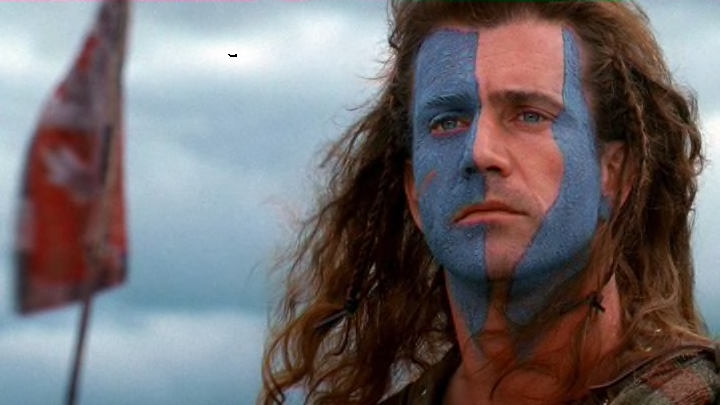
13. The distinctive face paint—called “woad”— is actually an anachronism.

It was never worn in battle at the time the movie takes place.

14. Gibson’s woad went through some revisions.

Gibson originally wanted to have St. Andrew’s Cross (a symbol of Scotland that appears on its contemporary flag) as the woad design on his face, but the film’s makeup artist, Lois Burwell, suggested the now iconic half-face-covering design. Good call by Burwell—she won the Oscar for Best Makeup for Braveheart .

15. Some of the warriors were real-life soldiers.

The production used reserve soldiers from the Irish territorial army as extras during the battle scenes. To save money, the same group played both Scottish and English forces and simply changed costumes depending on the angles Gibson wanted to shoot.

nextArticle.image_alt|e
Stephen Case
Meet the Artist Who's Drawing Every Character From Every Coen Brothers Movie Ever Made
Stephen Case
Stephen Case

Ethan and Joel Coen have directed 17 films spanning three decades, and in that time, they’ve brought some pretty memorable characters to life. They’ve given us the laid-back Dude from The Big Lebowski (1998), the bloodthirsty Anton Chigurh of No Country for Old Men (2007), and Ulysses, a charming “Dapper Dan man” who leads a band of escaped criminals in O Brother Where Art Thou (2000).

A caricature of Anton Chigurh
Javier Bardem as Anton Chigurh in No Country for Old Men
Stephen Case

As it turns out, these characters aren’t just enjoyable to watch—they’re also fun to draw, according to Hong Kong-based artist Stephen Case, who's currently making caricatures of every character from every Coen brothers film ever made. If you count major and minor characters—plus some of the more intriguing extras, and the cast of The Ballad of Buster Scruggs, a forthcoming anthology film—that works out to be well over 700 planned drawings.

This estimate is based on the 100-plus hours of research that Case has put into the project, a figure that doesn't include the time it takes to actually create each drawing. While this may seem like a daunting task, Case has enjoyed rewatching all 17 films, beginning with Blood Simple (1984) and ending with Hail, Caesar! (2016). Case said the idea for the project came from friend and fellow artist Harvey Chan, and it was an opportunity he couldn’t pass up.

“What I love about the Coens is, firstly, I'm a huge fan. One of my all-time favorite movies is The Big Lebowski, but they also have many other classics,” Case tells Mental Floss. “Secondly, all their characters are so ripe for caricature, from the lead characters down to the extras.”

Take, for instance, Chad—a dim-witted gym employee in Burn After Reading (2008) who's often seen with his mouth agape.

A caricature of Chad Feldheimer
Brad Pitt as Chad Feldheimer in Burn After Reading
Stephen Case/Netflix

While watching a movie, Case takes screenshots of the characters he wants to depict, then separates the images into individual computer files.

Next, it’s time to draw. He typically starts with a pencil sketch, then scans the image into his computer and uses Photoshop to digitally add in the color and brushwork. The goal is to achieve a likeness of the character without overexaggerating the features to the point where they're unrecognizable.

Ultimately, Case chooses which characters to include in the project. While he won't take on every extra ever shown in a Coen film, he says he will give characters with “decent screen time” or at least one line of dialogue their due diligence.

“For Raising Arizona, I'll only draw one of the babies rather than all of them, for example,” Case says, referring to the scene in which infertile ex-convict H.I. McDunnough, played by Nicolas Cage, kidnaps one of five babies belonging to a local businessman.

A caricature of H.I. McDunnough
Nicolas Cage as H.I. McDunnough in Raising Arizona
Stephen Case

Case also finds inspiration in characters that make an outsized impression for the relatively short time they spend on screen, like the mysterious visitor in the opening of A Serious Man (2009), who is believed to be a dybbuk (Yiddish evil spirit).

"This is going to be one of the best parts of this project—drawing faces like this," Case wrote in a caption accompanying the drawing. "Most of the Coen Bros characters are ripe for caricature, but faces like this are a gift from God ... or Yahweh ... or whoever."

Caricature of a Yiddish dybbuk
Fyvush Finkel as a Yiddish dybbuk in A Serious Man
Stephen Case/Netflix

The most obscure drawing he has completed so far, though, is of a curmudgeonly man who appears for one second in a painting hanging above Freddy Riedenschneider’s hotel bed in The Man Who Wasn’t There (2001).

“It's probably better to draw people as famous as possible, but with the Coens, some of the best characters are extras or those who have small parts,” Case says. “While they may be wasted on a lot of people, I figure fans of the movies will get a kick out of it.”

As for his favorite Coen character? “If I had to choose one it'd have to be John Goodman's Walter in The Big Lebowski,” Case says.

Some of his caricatures are currently on display at Swing A Cat, the art gallery and studio Case owns in Hong Kong. You can also check out his work on Patreon. He says he’s entertaining the idea of publishing a book of his Coen caricatures down the road.

So far, Case has finished about 35 drawings completely. And while he still has a long way to go to reach his goal, see if you can recognize some of the characters he's drawn already:

A caricature of Abby from Blood Simple
Frances McDormand as Abby in Blood Simple (1984)
Stephen Case

A caricature of Carlotta Valdez
Veronica Osorio as Carlotta Valdez in Hail, Caesar! (2016)
Stephen Case

A caricature of Carson Wells
Woody Harrelson as Carson Wells in No Country for Old Men (2007)
Stephen Case

A caricature of the Big Lebowski
Stephen Case
nextArticle.image_alt|e
Warner Bros.
12 Old Time Facts About Risky Business
Warner Bros.
Warner Bros.

On August 5, 1983, Tom Cruise—wearing Ray-Bans and his skivvies—starred in the teen dramedy Risky Business and slid his way into pop culture history. In his first starring role, Cruise dealt with a killer pimp named Guido, romanced a call girl named Lana, and charmed his way into Princeton. The film’s $63.5 million gross launched Cruise as a bona fide movie star, a title he still holds three decades later. Here are 12 things you might not know about the '80s classic, on its 35th anniversary.

1. AT ONE POINT THE MOVIE WAS TITLED WHITE BOYS OFF THE LAKE.

Because the movie took place, and was partly filmed, in Chicago’s affluent Highland Park suburb, located along Lake Michigan, writer-director Paul Brickman (who grew up in Highland Park) told Salon that, "The working title was White Boys Off the Lake. I think the studio rejected that because it sounded like an off-Broadway play. So we started doing word association to come up with a new title.”

2. IT WAS INSPIRED BY THE CONFORMIST.

Brickman also told Salon that Bernardo Bertolucci’s The Conformist was a huge influence on the film: “I thought, ‘Why can’t you present that as a film for youth and aspire to that kind of style and still have humor in it?’ That was the test: to meld a darker form of filmmaking with humor. Tone is what I wanted to play with.” Though Risky Business comes off as a satire about capitalism couched as a teen comedy, The Conformist is a political drama situated during Italy’s 1940’s Fascist regime.

3. THE DIRECTOR WAS NOT INITIALLY SOLD ON TOM CRUISE.


Warner Home Video

Cruise was filming The Outsiders in Tulsa, Oklahoma when he got the call to audition for Risky Business. Cruise told Interview, “Originally, Paul [Brickman] had seen Taps and said, ‘This guy for Joel? This guy is a killer! Let him do Amityville III!’ Somehow, my agent, without me knowing, arranged to have me just drop by the office to say hello. So I went in wearing a jean jacket, my tooth was chipped, my hair was greasy. I was pumped up and talking in an Oklahoma accent, ‘Hey, how y’all doing?’ Paul just sat there, looking at me.” Cruise returned to Tulsa but flew back to L.A. and auditioned again. “I walk in and see this stunningly gorgeous woman sitting there looking at me and I’m thinking, ‘Oh my God,’” Cruise said. “Rebecca [De Mornay] had already been cast. They wanted to see the two of us together. I tested, and to make a short story long, we didn’t test that well. Paul just believed in me.”

4. CRUISE LOST WEIGHT IN ORDER TO LOOK MORE BABY-FACED.

According to an interview with Cruise in a September 5, 1983 issue of People, Cruise “shed 14 pounds in five weeks by jogging in the Florida sun and strict dieting. When he had reached his weight goal, he stopped exercising ‘so I could put on a little layer of baby fat’ for his unathletic character.” Cruise explained, “[Joel's] a very vulnerable person. I didn’t want any physical defenses up for him. No muscle armor at all.”  

5. CRUISE IMPROVISED THE UNDERWEAR SCENE.

In what became the movie’s most iconic moment, Cruise uses a candlestick holder as a mic and dances around his house to Bob Seger’s 1978 song “Old Time Rock and Roll." “I was just looking for something that was a timeless rock and roll piece that wouldn’t be dated,” Brickman told Yahoo! of his song choice. The scene wasn’t filmed at the Highland Park-located house; it was filmed at a schoolhouse in Skokie, Illinois.

Cruise told Cameron Crowe how the scene unfurled: “So I took the candlestick, and I said, ‘How about making this the audience?’ And then I just started ad libbing, using it as a guitar, jumping on the table. I waxed half the floor and kept the other half dirty, so I could slide in on my socks. As we went along, I threw more stuff in. Like the thing with the collar up, jumping on the bed. Originally, it was only one line in the script: ‘Joel dances in underwear through the house.’ We shot it in half a day.” And Cruise danced his way into history.

6. SEVERAL PARODIES EXIST OF THE SEGER DANCE SCENE—INCLUDING TWO INVOLVING BEN STILLER.

When Ron Reagan, Jr. hosted a 1986 episode of SNL, the cold open entailed Reagan being home alone at the White House, where he does what any First Kid would do: strip down to his underwear and dance to “Old Time Rock and Roll." During a scene in Scrubs, three of the characters hilariously recreate the dance moment. A 1992 episode of The Ben Stiller Show involves Stiller doing a spot-on impression of Cruise, who in the sketch is turning his life into a musical called Tom Cruise: Dress Casual, replete with a snippet of the underwear scene. Then, at the 2000 MTV Movie Awards, Stiller once again parodied Cruise—but this time as Cruise’s stunt double. Cruise appears in the skit as himself and allows Stiller to once again act out the underwear scene. The Stiller/Cruise comedic partnership continued years later when the good-humored Cruise worked with Stiller in the Stiller-directed 2008 film Tropic Thunder.

7. SEVERAL PORSCHE 928S WERE USED IN THE FILM.

“Porsche, there is no substitute,” Joel says as he speeds around town in his dad’s Porsche, only to have it later sink into Belmont Harbor. Porsche manufactured the 928 model from 1978 to 1995, and it was the first mass-produced Porsche with a V8 engine. Four of the 1979 models show up in the movie (and a 1981 model), including one that was gutted for the lake scene, and another that was painted gold. A collector tried to track down all of the Porsches but only found one of them, which he bought for $49,200 at a 2012 Hollywood memorabilia auction.

8. CRUISE THINKS THE FILM IS ABOUT CAPITALISM.

Ten years prior to casting Tom Cruise in Jerry Maguire, Cameron Crowe spoke with Cruise for Interview and asked him what he thought Risky Business was about. “It’s about today’s capitalistic society,” Cruise said, in 1986. “Do the means justify the ends? Do you want to help people, or do you just want to make money? Joel is questioning all of that. So am I ... I’m not saying I’m some erudite political figure—but it bothers me. At least I’m asking the question. The movie is Joel’s exploration of society, how he gets sucked into this wild capitalistic ride.”

9. THE MANUFACTURER OF THE CRYSTAL EGG WENT OUT OF BUSINESS IN 2011.

“I’m very disappointed in you,” Joel’s mom tells her son after she comes home from vacation to find her prized crystal egg cracked. Earlier in the film, hookers steal the egg from the mantel but return it to Joel by throwing it like a football. In real life, the egg was made by a century-old Corning, New York manufacturer named Steuben Glass Works, who made all kinds of prized pieces until they shuttered operations in 2011, mainly because the demand for crystal declined post-recession.

10. THE FILM WAS THE MOVIE DEBUT OF BOTH MEGAN MULLALLY AND BRONSON PINCHOT.

Before she was a Emmy-winning actress, Megan Mullally played a hooker in Risky Business. Wearing pink lingerie and with a cigarette dangling out of her mouth, she appears for just a few seconds. In the end credits she’s listed as “Call Girl.” Bronson Pinchot has much more screen time starring as Joel’s wise-cracking friend Barry. In a 2009 interview with The A.V Club, Pinchot said working with Cruise was “weird” and called Cruise “the biggest bore on the face of the Earth.”

11. TOM CRUISE AND REBECCA DE MORNAY DATED IN REAL LIFE.

Cruise has always been coy about his private life, but in 1986 he opened up to Rolling Stone about a girlfriend whom he fell in love with. “That girlfriend was his Risky Business costar, Rebecca De Mornay,” reads the article. “Despite their incendiary love scenes, they didn’t start dating until after the film’s release in late summer of 1983.” The long-distance relationship dissolved some time after Cruise shot the film Legend, in London, and before he went off to film Top Gun. “Relationships are hard,” Cruise told the magazine. “You have to know when you’re going to be in a different place from someone else, you have to have the strength to separate.” In 1987, Cruise married his first wife, actress Mimi Rogers.

12. TWO ENDINGS WERE SHOT, BUT BRICKMAN ONLY LIKED THE ORIGINAL.

At the end of Risky Business, Joel dines at a restaurant with Lana and he says, “I was just thinking where we’ll be in 10 years,” and she says they’re going to make it big. He asks, “Was this a setup?” and she says, “No.” Cut to them walking through a park at night and them talking about how they won’t be seeing each other for a while. She asks to spend the night with him and he jokingly asks if she has any money, and then his voiceover kicks in: “My name is Joel Goodsen. I deal in human fulfillment. I grossed over $8,000 in one night ... Time of your life, huh, kid?”

But in the alternate ending, they dine at the same restaurant and have a similar conversation. “Was our night together just a setup?” he asks Lana and she says “no” then adds “Why does it have to be so tough?” He summons her to come over and sit on his lap, which she does. The camera pulls back to reveal a stunning view of Lake Michigan (it’s obvious they’re dining inside the Hancock building). While still on his lap, the couple embrace and Joel’s voiceover is exactly the same except “time of your life” gets changed to “isn’t life grand?”—a subtle yet more sarcastic and ambiguous ending.

“We had to change the ending to make it more upbeat and commercial,” Cruise told Cameron Crowe. “Geffen Films felt it was too ... basically they felt it was a bummer, okay? At one point, Paul [Brickman] said he wouldn’t direct the new ending. They were going to hire another director to direct it. Paul really fought it. We all did … In the end, I think we got across the same point, though. Joel knows in his heart that this woman is more important than money.” At a 30th anniversary screening of the film, Brickman finally showed an audience the ending he had intended for the film.

SECTIONS

arrow
LIVE SMARTER
More from mental floss studios