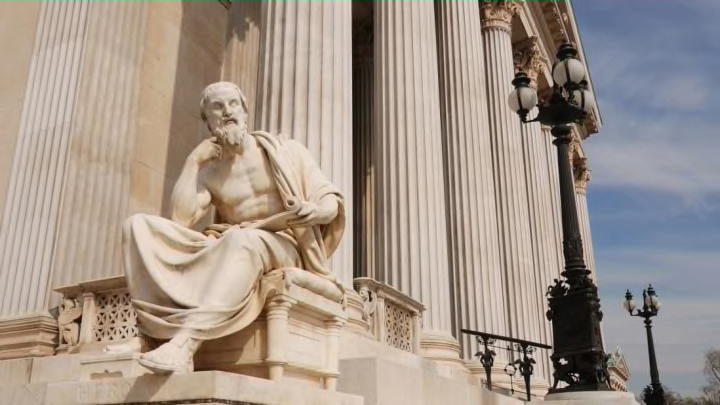
13 Bizarre Descriptions of the Ancient World According to Herodotus's Histories

iStock.com/shishic
iStock.com/shishic

Widely considered one of the first serious works of history, Histories—written in the 5th century BCE by the Greek scholar Herodotus—is a highly influential account of the Greco-Persian wars, and offers one of the best glimpses into ancient cultures. Herodotus was remarkably scrupulous with his research, traveling across Europe and the Middle East to interview countless people. “[M]y rule in this history is that I record what is said by all as I have heard it,” he’d write.

Unfortunately, many of those people, it appears, lied to his face: Despite its merits, Histories is stuffed with whimsical inaccuracies. Consequently, some scholars have given Herodotus—dubbed the “Father of History”—a second sobriquet: “The Father of Lies.” As Tom Holland, a Herodotus translator, told The Telegraph: “The Histories are a great shaggy-dog story.” Here are some colorful passages (some of which may stretch the truth).

1. It was an honor to be eaten after your (sacrificial) death.

Herodotus had this to say of the Massagetae, a group who lived east of the Caspian Sea. “[W]hen a man is very old, all his relatives give a party and include him in a general sacrifice of cattle; then they boil the flesh and eat it. This they consider to be the best sort of death. Those who die of disease are not eaten but buried, and it is held a misfortune not to have lived long enough to be sacrificed.”

2. Egyptians loved cats so much they’d save them from a burning building.

Any devout cat-lover can imagine the following scene: “What happens when a house catches fire is most extraordinary: Nobody takes the least trouble to put it out, for it is only the cats that matter: every one stands in a row, a little distance from his neighbor, trying to protect the cats.”

3. In fact, they mourned their pet's death by shaving their eyebrows.

Perhaps the Egyptians loved their pets a little too much: “All the inmates of a house where a cat has died a natural death shave their eyebrows, and when a dog dies they shave the whole body including the head.”

4. In Babylon, women were auctioned into marriage based on looks.

“Once a year all the girls of marriageable age used to be collected together in one place, while the men stood round them in a circle; an auctioneer then called each one in turn to stand up and offered her for sale, beginning with the best-looking and going on to the second best as soon as the first had been sold for a good price.” (However, Herodotus noted that this practice was obsolete by his time; as with his other "facts," the veracity is debated.)

5. The desert was full of gigantic, terrifying ants.

Herodotus had this to say about India: “There is found in this desert a kind of ant of great size bigger than a fox, though not so big as a dog … These creatures as they burrow underground throw up the sand in heaps, just as our own ants throw up the earth, and they are very much like ours in shape.” (In 1996, a team of explorers theorized that Herodotus's ants, which were also said to dig up gold, were actually large marmots—which have been known to kick up gold dust in an area near the Indus River as they build their burrows.)

6. And hippos were basically a big, leathery horse.

Consider this description of a hippo, which Herodotus clearly never saw: “This animal has four legs, cloven hoofs like an ox, a snub nose, a horse’s mane and tail, conspicuous tusks, a voice like a horse’s neigh, and is about the size of a very large ox. Its hide is so thick and tough that when dried it can be made into spear-shafts.” (To say the least, Histories is not a very good biology resource.)

7. In Babylon, strangers were required to give you unsolicited medical advice.

Babylon sounds like an ill introvert’s nightmare: “They have no doctors, but bring their invalids out into the street, where anyone who comes along offers the sufferer advice on his complaint, either from personal experience or observation or similar complaint in others … Nobody is allowed to pass a sick person in silence; but one must ask him what is the matter.”

8. The Persians were extremely good at delivering mail.

“No mortal thing travels faster than these Persian couriers," Herodotus writes. "The whole idea is a Persian invention, and works like this: riders are stationed along the road, equal in number to the number of days the journey takes—a man and a horse for each day. Nothing stops these couriers from covering their allotted stage in the quickest possible time—neither snow, rain, heat, nor darkness.” (If that sounds familiar, it's because these lines inspired the USPS’s unofficial "neither snow nor rain ..." motto [PDF]).

9. Some women in Libya wore adornments indicating their number of sexual conquests.

Herodotus describes the Gindane people of Libya like this: “The women of this tribe wear leather bands round their ankles, which are supposed to indicate the number of their lovers: each woman puts on one band for every man she has gone to bed with, so that whoever has the greatest number enjoys the greatest reputation because she has been loved by the greatest number of men.” (Incidentally, Herodotus also believed the Gindanes lived among the mythical Lotus Eaters, who were famous for their apathy.)

10. In Bulgaria, death was a cause for celebration!

According to Herodotus, the Trausi, a tribe living in the Rhodope mountains of southeastern Europe, celebrated birth and death a little differently: “When a baby is born the family sits round and mourns at the thought of the sufferings the infant must endure now that it has entered the world, and goes through the whole catalogue of human sorrows; but when somebody dies, they bury him with merriment and rejoicing, and point out how happy he now is and how many miseries he has at last escaped.”

11. Ethiopia was full of hole-dwelling people who shrieked like bats.

The Garamantes were a tribe in Libya. According to “The Father of History,” they passed their time by hunting quick-footed trolls: “[They] hunt the Ethiopian hole-men, or troglodytes, in four-horse chariots, for these troglodytes are exceedingly swift of foot—more so than any people of whom we have information. They eat snakes and lizards and other reptiles and speak a language like no other, but squeak like bats.”

12. Egyptians overcame baldness with the power of the sun.

“I noticed that the skulls of the Persians are so thin that the merest touch with a pebble will pierce them, but those of the Egyptians, on the other hand, are so tough that it is hardly possible to break them with a blow from a stone. I was told, very credibly, that the reason was that the Egyptians shave their heads from childhood, so that the bone of the skull is hardened by the action of the sun—this is also why they hardly ever go bald, baldness being rare in Egypt than anywhere else.”

13. Sea nymphs could save the day! (Maybe.)

Even for Herodotus, some stories were just too crazy to accept—like this tale describing a naval fleet caught in a rough weather: “The storm lasted three days, after which the Magi brought it to an end by sacrificial offerings, and by putting spells on the wind, and by further offerings to Thetis and the sea-nymphs—or, of course, it may be that the wind just dropped naturally.”

There you have it: If you want to know where Herodotus draws the line, it’s weather-conjuring sea-nymphs.

Why Was Paul McCartney Barefoot on the Cover of Abbey Road?

It has been half a century since The Beatles’ Abbey Road album cover was shot on August 8, 1969, and the conspiracy theories about Paul McCartney’s bare feet are still alive.

In the late 1960s, the rumor started circulating among Beatles fans that "the Cute One" had died in a car crash in 1967. Because they didn’t want to impact the popularity of the band, managers and handlers allegedly hired a McCartney look-alike as a replacement. The band felt bad about lying to loyal fans, however, and began leaving clues in the album artwork to tip them off.

One such "clue" was the entire cover of the Abbey Road album. Fans deduced that a simple picture of the band crossing the road was actually meant to depict a funeral procession. John, in white, was the clergyman. Ringo’s black attire showed that he was the mourner, while George’s casual jeans meant he was the gravedigger. Paul’s bare feet were the kicker: He didn’t need shoes, because he was the dearly departed.

If you’re not one of those conspiracy theorists, here’s the real story: It was hot. In some other pictures that were taken at the shoot, you can see McCartney making a fashion statement by wearing sandals with his suit. At some point during the brief shoot, he kicked them off. They didn't have much time to get the shot—because photographer Iain Macmillan had to perch on a stepladder in the middle of the very busy street, while police had to help stop traffic. So the Fab Four crossed the road one way, and Macmillan snapped three pictures. They let some traffic go by, then crossed the other way for another three pictures. Six pictures—that was it.

McCartney and Macmillan chose the picture they did because it was the only one that showed the Beatles with their legs all mid-stride in a “V” shape, though McCartney is famously out of step (another "clue," of course).

“On Abbey Road we were wearing our ordinary clothes. I was walking barefoot because it was a hot day,” an exasperated McCartney told a LIFE magazine reporter who “waded through a bog in Scotland” to reach the Beatle at his farm in 1969. “Can you spread it around that I am just an ordinary person and want to live in peace?” He no doubt regretted suggesting the cover to begin with.

Though the photo arrangement was his idea, it was intended to show the Beatles walking away from the studio where they had spent so much time for the better part of a decade—not fuel more rumors.

10 Famous People Who Were Afraid They'd Be Buried Alive

L'Inhumation Precipitee or "The Premature Burial" by Belgian artist Antoine Wiertz
Hulton Archive/Getty Images

The fear of being buried alive may be an ancient obsession—Pliny the Elder recorded cases among the Romans in his Natural History, written in 77 CE. But the golden age for this particular phobia was the Victorian era, when a sensationalist press met a public fascination with death (and some spotty science) to create a cottage industry of books and inventions devoted to premature burial and, most importantly, its prevention. Groups like the London Association for the Prevention of Premature Burial mushroomed, as did alarmist texts like One Thousand Persons Buried Alive by their Best Friends (published by a Boston doctor in 1883).

Getting trapped six feet deep inside a coffin was a favorite plot device for Gothic writers, as it was for Edgar Allan Poe, whose 1844 story, “The Premature Burial” (among other works), contributed to the public preoccupation with the subject. By 1891, Italian psychiatrist Enrico Morselli said fears of premature burial were so widespread it was time to create an official medical term [PDF]. He coined the word taphephobia (Greek for “grave” + “fear”). As Morselli described it, “The taphephobic … is an unhappy person, his every day, his every hour being tormented by the sudden occurrence of the idea of being buried alive.”

Rampant taphephobia also led to the creation of so-called “safety coffins,” designed to prevent premature burial. Germany alone saw more than 30 of these designs patented in the second half of the 19th century. Most involved some mechanism for communicating with the living, such as ropes and other tools that were used to ring bells above ground (some safety coffins also included supplies of air, food, and water). In 1822, one Dr. Adolf Gutsmuth of Seehausen, Altmark (modern-day Germany), demonstrated his design by having himself buried alive, where he “stayed underground for several hours and had a meal of soup, beer, and sausages served through the coffin's feeding tube.”

Ten famous taphephobes are listed below, and while not all were gripped by a full-blown phobia, they all made provisions to avoid being declared dead before their time.

1. Hans Christian Andersen

Author Hans Christian Andersen
Hulton Archive/Getty Images

According to his biographer Jackie Wullschlager, Danish writer Hans Christian Andersen was deathly afraid of being buried alive. He spent his final days at the home of his friends Dorothea and Moritz Melchior in Copenhagen, and as the end neared, begged Dorothea to cut his veins after he’d breathed what appeared to be his last breath. Dorothea “joked that he could do as he had often done, and leave a note saying ‘I only appear to be dead' beside him.”

The note was a fixture of Andersen’s bedside table—some say he even wore it around his neck. Andersen was more than a little neurotic, and being buried alive was far from his only fear. According to Wullschlager, he also traveled with a rope in his luggage because he was afraid of fire, was terrified of dogs, and refused to eat pork out of fear of trichinosis.

2. Frédéric Chopin

Polish composer Frederic Chopin
Hulton Archive/Getty Images

In his last written message, composer Frédéric Chopin is believed to have penned the words (in French): “The earth is suffocating. Swear to make them cut me open, so I won’t be buried alive.” (Some biographers translate the scrawled word “earth” as “cough”—Chopin was diagnosed with tuberculosis.) Chopin’s precise cause of death has never been determined, though researchers have long wanted to study his heart, entombed in alcohol in the pillar of a Warsaw church, to test the theory that he might have died of cystic fibrosis.

3. George Washington

George Washington
George Washington
Three Lions/Getty Images

A few hours before he died, George Washington said to his secretary: "I am just going. Have me decently buried; and do not let my body be put into the Vault in less than three days after I am dead." The request wasn't uncommon for his time: Before the invention of modern stethoscopes, the onset of putrefaction—which generally happens to corpses within a couple of days—was the only sure sign of death.

His nephew, United States Supreme Court Justice Bushrod Washington, was even more explicit in his protections against premature burial. He told his doctor: “[M]y thumbs are not to be tied together—nor anything put on my face or any restraint upon my Person by Bandages, &c. My Body is to be placed in an entirely plain coffin with a flat Top and a sufficient number of holes bored through the lid and sides—particularly about the face and head to allow Respiration if Resuscitation should take place and having been kept so long as to ascertain whether decay may have occurred or not, the coffin is to be closed up.”

4. Edward Bulwer-Lytton

Victorian novelist and politician Edward Bulwer-Lytton is to blame for the phrase “It was a dark and stormy night.” (The line has since spawned the Bulwer-Lytton Fiction Contest, where entrants compete each year to create the worst opening lines in literature.) But spare some pity for the guy: He was so concerned about one day waking up in a coffin that he asked for his heart to be punctured before he was buried, just in case.

5. Alfred Nobel

Alfred Nobel
Alfred Nobel
Hulton Archive/Getty Images

Alfred Nobel was the inventor of dynamite. Although invented for non-military purposes, he felt that his invention would help bring about peace by making war unpalatable.The Nobel Prizes were created by his will, which left the bulk of his vast estate to the creation of a fund for prizes awarded to those who “conferred the greatest benefit on mankind" in the preceding year. The final portion of Nobel’s will, however, reflected a different preoccupation. He wrote: "It is my express wish that following my death my veins shall be opened, and when this has been done and competent Doctors have confirmed clear signs of death, my remains shall be cremated in a so-called crematorium.”

6.Auguste Renoir

Auguste Renoir
Auguste Renoir 
Hulton Archive/Getty Images

According to a memoir by his son Jean Renoir, the French painter Auguste Renoir repeatedly expressed a fear of being buried alive. His son insisted a doctor do "whatever was necessary" to ensure the artist was really and truly dead before being buried.

7. Arthur Schopenhauer

Arthur Schopenhauer
Arthur Schopenhauer 
Hulton Archive/Getty Images

According to the historian Jan Bondeson, the influential German philosopher Arthur Schopenhauer "freely admitted to a fear of premature interment.” He requested that his corpse stay aboveground for five days, so it would be good and rotten before burial.

8. Nikolai Gogol

Russian author Nikolai Gogol (famous for his short story “The Overcoat” and the novel Dead Souls) was both fascinated and terrified by the prospect of premature burial. He wrote in a letter to a friend that he was amazed humans could stay in a trance and see, hear, and feel, without being able to do anything to prevent premature burial. His will specified that he not be buried until he was putrefying and without a heartbeat.

Supposedly, when Gogol was exhumed several decades later (Russian authorities had decided to demolish the cemetery where he’d been buried), his body had shifted and was lying on its side, giving rise to a legend that his worst fear had come true—he’d been buried alive. While it’s tempting to believe such a dramatic story, corpses can shift after death thanks to putrefaction and earth movements.

9. Johann Nepomuk Nestroy

According to Bondeson, Austrian writer Johann Nepomuk Nestroy took elaborate precautions against premature burial:

In his will, he declared that the risk of premature burial was the only thing he feared in his present situation and that his studies of the literature on this subject had taught him that the doctors could not be relied on to distinguish dead people from living ones. His body was to be kept in an open coffin for two days, in a waiting mortuary with a signaling apparatus that would herald any signs of life. Even after burial, the coffin lid was not to be nailed shut.

10.Philip Stanhope, 4th Earl of Chesterfield

Philip Stanhope, the 4th Earl of Chesterfield, was a British statesman and wit who is now perhaps best known for the letters to his illegitimate son that he wrote almost daily for 30 years, beginning in 1737. (Not everyone was a fan: After the letters were first published in 1774, Samuel Johnson wrote that they taught "the morals of a whore and the manners of a dancing-master.") While not exactly crippled by a fear of premature burial, Stanhope made reference to the predicament in a letter to his son’s wife written in 1769: “All I desire for my own burial is not to be buried alive; but how or where, I think, must be entirely indifferent to every rational creature."

This story was first published in 2015 and republished in 2019.

SECTIONS

arrow
LIVE SMARTER