iStock
iStock

38 Wonderful Words With No English Equivalent

iStock
iStock

Sometimes we must turn to other languages to find le mot juste. Here are a whole bunch of foreign words with no direct English equivalent.

1. Kummerspeck (German)
Excess weight gained from emotional overeating. Literally, grief bacon.

2. Shemomedjamo (Georgian)
You know when you’re really full, but your meal is just so delicious, you can’t stop eating it? The Georgians feel your pain. This word means, “I accidentally ate the whole thing."

3. Tartle (Scots)
The nearly onomatopoeic word for that panicky hesitation just before you have to introduce someone whose name you can't quite remember.

4. Mamihlapinatapai (Yaghan language of Tierra del Fuego)
This word captures that special look shared between two people, when both are wishing that the other would do something that they both want, but neither want to do.

5. Backpfeifengesicht (German)
A face badly in need of a fist.

6. Iktsuarpok (Inuit)
You know that feeling of anticipation when you’re waiting for someone to show up at your house and you keep going outside to see if they’re there yet? This is the word for it.

7. Pelinti (Buli, Ghana)
Your friend bites into a piece of piping hot pizza, then opens his mouth and sort of tilts his head around while making an “aaaarrrahh” noise. The Ghanaians have a word for that. More specifically, it means “to move hot food around in your mouth.”

8. Greng-jai (Thai)
That feeling you get when you don't want someone to do something for you because it would be a pain for them.

9. Mencolek (Indonesian)
You know that old trick where you tap someone lightly on the opposite shoulder from behind to fool them? The Indonesians have a word for it.

10. Faamiti (Samoan)
To make a squeaking sound by sucking air past the lips in order to gain the attention of a dog or child.

11. Gigil (Filipino)
The urge to pinch or squeeze something that is irresistibly cute.

12. Yuputka (Ulwa)
A word made for walking in the woods at night, it’s the phantom sensation of something crawling on your skin.

13. Zhaghzhagh (Persian)
The chattering of teeth from the cold or from rage.

14. Vybafnout (Czech)
A word tailor-made for annoying older brothers—it means to jump out and say boo.

15. Fremdschämen (German); Myötähäpeä (Finnish)
The kinder, gentler cousins of Schadenfreude, both these words mean something akin to "vicarious embarrassment.”

16. Lagom (Swedish)
Maybe Goldilocks was Swedish? This slippery little word is hard to define, but means something like, “Not too much, and not too little, but juuuuust right.”

17. Pålegg (Norwegian)
Sandwich Artists unite! The Norwegians have a non-specific descriptor for anything – ham, cheese, jam, Nutella, mustard, herring, pickles, Doritos, you name it – you might consider putting into a sandwich.

18. Layogenic (Tagalog)
Remember in Clueless when Cher describes someone as “a full-on Monet…from far away, it’s OK, but up close it’s a big old mess”? That’s exactly what this word means.

19. Bakku-shan (Japanese)
Or there's this Japanese slang term, which describes the experience of seeing a woman who appears pretty from behind but not from the front.

20. Seigneur-terraces (French)
Coffee shop dwellers who sit at tables a long time but spend little money.

21. Ya’arburnee (Arabic)
This word is the hopeful declaration that you will die before someone you love deeply, because you cannot stand to live without them. Literally, may you bury me.

22. Pana Po’o (Hawaiian)
“Hmm, now where did I leave those keys?” he said, pana po’oing. It means to scratch your head in order to help you remember something you’ve forgotten.

23. Slampadato (Italian)
Addicted to the UV glow of tanning salons? This word describes you.

24. Zeg (Georgian)
It means “the day after tomorrow.” OK, we do have "overmorrow" in English, but when was the last time someone used that?

25. Cafune (Brazilian Portuguese)
Leave it to the Brazilians to come up with a word for “tenderly running your fingers through your lover’s hair.”

26. Koi No Yokan (Japanese)
The sense upon first meeting a person that the two of you are going to fall in love.

27. Kaelling (Danish)
You know that woman who stands on her doorstep (or in line at the supermarket, or at the park, or in a restaurant) cursing at her children? The Danes know her, too.

28. Boketto (Japanese)
It’s nice to know that the Japanese think enough of the act of gazing vacantly into the distance without thinking to give it a name.

29. L’esprit de l’escalier (French)
Literally, stairwell wit—a too-late retort thought of only after departure.

30. Cotisuelto (Caribbean Spanish)
A word that would aptly describe the prevailing fashion trend among American men under 40, it means one who wears the shirt tail outside of his trousers.

31. Packesel (German)
The packesel is the person who’s stuck carrying everyone else’s bags on a trip. Literally, a burro.

32. Hygge (Danish)
Denmark’s mantra, hygge is the pleasant, genial, and intimate feeling associated with sitting around a fire in the winter with close friends.

33. Cavoli Riscaldati (Italian)
The result of attempting to revive an unworkable relationship. Translates to "reheated cabbage."

34. Bilita Mpash (Bantu)
An amazing dream. Not just a "good" dream; the opposite of a nightmare.

35. Litost (Czech)
Milan Kundera described the emotion as “a state of torment created by the sudden sight of one’s own misery.”

36. Luftmensch (Yiddish)
There are several Yiddish words to describe social misfits. This one is for an impractical dreamer with no business sense.

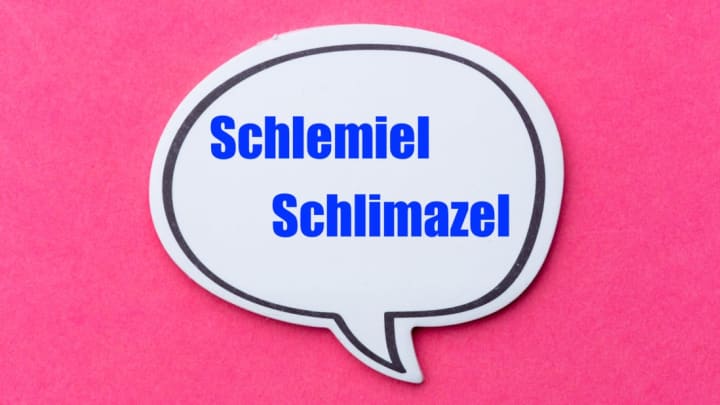
37 & 38. Schlemiel and schlimazel (Yiddish)
Someone prone to bad luck. Yiddish distinguishes between the schlemiel and schlimazel, whose fates would probably be grouped under those of the klutz in other languages. The schlemiel is the traditional maladroit, who spills his coffee; the schlimazel is the one on whom it's spilled.

We compiled many of these words in these three posts from 2011 and 2012.

nextArticle.image_alt|e
iStock
arrow
Words
12 Different Ways to Say 'Doughnut' Across the U.S.
iStock
iStock

On National Doughnut Day, the holiest of high fat holidays (hole-y, get it?), we celebrate the delicious pastry, from the plain to the just plain crazy. Not only can you get your grubby hands on free doughnuts today, you’re getting a bunch of regional doughnut lingo right here. With the editors of the Dictionary of American Regional English (DARE), we explore the different ways people say doughnut across the United States and bring you a dozen to sink your teeth into.

1. CHOKER HOLE

Choker hole is originally a logging term from the Pacific Northwest. It refers to a small hole dug under a log so that a choker—a rope or wire formed in the shape of a noose—can go under the log for hauling. Due to its resemblance, loggers nicknamed the doughnut "choker hole."

2. COOKIE

If you really want to confuse your friends, call a doughnut a cookie. Popular in the Southern and South Midland states, this term probably comes from the Dutch koekje, meaning a “small sweetened cake.”

3. FETTIGLICH

In German communities in Missouri, you might hear doughnuts referred to as fettiglich. The word probably comes from the German fettig, meaning fatty or greasy. According to a quote in DARE, a fall tradition in Missouri involved masked children going door to door, saying, “Fettiglich, fettiglich,” to which people would respond by giving them doughnuts, a practice which should definitely be revived for Doughnut Day.

4. OLYKOEK

Olykoek is an early term for doughnut that hails from the Hudson Valley in New York. One of the earliest recorded usages is from Washington Irving in his 1809 book A History of New York: “The table ... was always sure to boast an enormous dish of balls of sweetened dough, fried in hog’s fat, and called dough nuts, or oly koeks.” Olykoek is a variation on the Dutch oliekoek, which translates as “oil cake.”

5. SUBMARINE

While a submarine is familiar as a sandwich in some parts of the U.S., it has also been a name for a doughnut in states like Kansas, Minnesota, West Virginia, and New York. Alternatively called a sinker, the name submarine comes from the idea of a doughnut being submerged in oil or fat, according to the Oxford English Dictionary (OED).

6. FRIED NUT

If you’re ever in New Hampshire and get offered a fried nut, take it! It's an old-fashioned term for a doughnut. The "nut" of fried nut (and of doughnut, for that matter) comes from the idea that earlier doughnuts—which didn’t have holes—looked like nuts.

7. CYMBAL

An old-timey New England term, cymbal refers to a doughnut without a hole, according to a quote in DARE. A doughnut with a hole might have come from a sea captain, at least according to an early 1930s quote from the Linguistic Atlas of New England. Boston native Oliver Wendell Holmes called the cymbal “a kind of genteel doughnut.”

8. COLD SHUT

Ever bite into a tough, day-old doughnut? That might be called a cold shut in the Pacific Northwest. Cold shut was originally a welding term referring to a link that was closed “while cold” and without welding.

9. KOLACKY

A kolacky is a doughnut with a sweet filling, as well as a pastry made of pie dough and topped with something sweet. The term is chiefly used in Wisconsin and the Upper Midwest states, and is a variation on the Czech kolač, which comes from kolo, meaning wheel or circle. DARE’s earliest recorded use of a form of kolacky is from Willa Cather’s novel My Ántonia, which is about a family of “Bohemian” immigrants: “Show him the spiced plums, mother. Americans don’t have those ... Mother uses them to make kolaches.”

10. BERLINER

In Wisconsin and craving a jelly doughnut? Ask for a Berliner. If wreath-shaped pastries are more your thing, you can find the Berliner kranser in Scandinavian settlement areas like Minnesota. Despite its German-sounding name, Berliner kranser is actually Norwegian and translates as "Berlin wreath."

11. TANGLE BREECHES

Tangle breeches is a nickname for the cruller in states like Pennsylvania, Maryland, Nebraska, Kansas, and Alabama. What’s a cruller? Basically a doughnut in a twisty shape. The term cruller, chiefly used in the North Central and Central Atlantic states, comes from the Dutch krulle, a curled cake.

12. MATRIMONY

The matrimony sounds like a delicious union: two crullers joined by another piece of dough. Such a doughnut might be found in Massachusetts and Rhode island.

This story originally ran in 2016.

nextArticle.image_alt|e
Alex Wong, Getty Images
arrow
Lists
25 Facts About the Scripps National Spelling Bee
Alex Wong, Getty Images

Call it the Super Bowl of Spelling. This week, a record 516 pint-sized spellers are sweating out their ABCs in the Maryland Ballroom of the Gaylord National Resort and Convention Center in National Harbor, Maryland, hoping to be crowned the 2018 Scripps National Spelling Bee champion. You may know how to spell “victory,” but here are 25 things you might not know about the country’s best-known gathering of logophiles.

1. IT WAS ORGANIZED BY A NEWSPAPER.

The National Spelling Bee was inaugurated in 1925 by Kentucky’s Louisville Courier-Journal as a way to consolidate a number of local spelling bees and generate “general interest among pupils in a dull subject.” (Cash prizes have a tendency to do that.) The E.W. Scripps Company didn’t take ownership of the Bee until 1941.

2. FRANK NEUHAUSER WAS THE BEE’S FIRST OFFICIAL CHAMPION.

Neuhauser, an 11-year-old from Louisville, Kentucky, beat out eight other finalists to become the National Spelling Bee’s first champion. His word for the win? Gladiolus. Yes, the flower. On March 22, 2011, Neuhauser—a retired lawyer—passed away at his home in Silver Spring, Maryland at the age of 97.

3. IN 1926, PAULINE BELL BECAME THE FIRST FEMALE CHAMPION.

In the Bee’s second year, it declared its first female winner, Pauline Bell, who won by correctly spelling the color cerise. Bell kicked off a trend of female winners: Of the Spelling Bee’s 93 champions, 48 of them have been girls. This year, 45 percent of the competitors are girls.

4. THERE WERE NO WINNERS IN 1943, 1944, OR 1945.

That’s because the Spelling Bee was put on hold during World War II.

5. THERE WERE TWO WINNERS ON SIX OCCASIONS

Spellers Nihar Saireddy Janga and Jairam Jagadeesh Hathwar hold a trophy after the finals of the 2016 Scripps National Spelling Bee
Alex Wong, Getty Images

Co-champions have long been a possibility at the National Spelling Bee, and were a reality in 1950, 1957, 1962, 2014, 2015, and 2016, when 11-year-old Nihar Janga of Austin, Texas, and 13-year-old Jairam Hathwar of Corning, New York, both walked away winners. To prevent this continuing trend, the Bee changed the rules in 2017 by requiring all of the spellers still standing at 6 p.m. on the Bee's final day to complete a written test to be used to break a tie.

6. THE BEE WAS FIRST TELEVISED IN 1946.

The Bee’s national finals were first broadcast live on NBC in 1946. Portions of the Spelling Bee have since been broadcast on PBS and ABC as well. But since 1994, ESPN has been the Bee’s biggest champion, broadcasting near-constant spelling action throughout the entire competition.

7. NO ONE REALLY KNOWS WHERE THE WORD “BEE” COMES FROM.

According to the folks at Scripps:

"The word ‘bee,’ as used in ‘spelling bee,’ is one of those language puzzles that has never been satisfactorily accounted for. A fairly old and widely-used word, it refers to a community social gathering at which friends and neighbors join together in a single activity (sewing, quilting, barn raising, etc.) usually to help one person or family.

"The earliest known example in print is a spinning bee, in 1769 ... Spelling bee is apparently an American term. It first appeared in print in 1875, but it seems certain that the word was used orally for several years before that."

8. MERRIAM-WEBSTER'S UNABRIDGED DICTIONARY IS THE SPELLING BEE BIBLE.

With more than 472,000 word entries, it’s the official dictionary [PDF] of the Scripps National Spelling Bee—and the only one that counts in terms of spelling.

9. KIDS ARE GIVEN A TOTAL OF TWO MINUTES TO SPELL A WORD.

The countdown begins when the pronouncer first pronounces the word.

10. “KNAIDEL” CAUSED A CONTROVERSY IN 2013.

 Arvind Mahankali of Bayside Hills, New York holds his trophy as president of the E.W. Scripps Company Rich Boehne looks on after the finals of the 2013 Scripps National Spelling Bee
Alex Wong, Getty Images

In 2013, New Yorker Arvind Mahankali won the competition by spelling the word “knaidel,” another word for matzo ball. While a number of Yiddish speakers claimed that Mahankali's spelling was incorrect, the then-13-year-old's spelling of the word was the same as Merriam-Webster's, leading the event’s organizers to declare that there was no controversy at all.

11. A TRAFFIC LIGHT HELPS SPELLERS KEEP TRACK OF THE TIME.

Spellers have the benefit of viewing a monitor with a traffic light to keep track of time. For the first 75 seconds, the traffic light is green, followed by 15 seconds of yellow. At the 30-second mark, the light turns red and a countdown clock appears. Neither the judges nor the pronouncer can communicate with the speller once the monitor has shifted into “red light mode.”

12. PRONOUNCER DR. JACQUES BAILLY IS A CHAMPION SPELLER, TOO.

For the past 16 years, Dr. Jacques Bailly has served as the Spelling Bee’s official pronouncer, and was an associate pronouncer for 12 years before that. But his history with the Spelling Bee goes back even further—all the way back to 1980, when he won the whole shebang at the age of 14 by correctly spelling elucubrate.

13. DR. BAILLY DOESN’T PLAY FAVORITES.

“I always want them to get all the words right,” Bailly told TIME in 2009 about sympathizing with the entire lineup of spellers. “I think that's a lot of the fun of the spelling bee—you root for everybody. And I try to make it clear to the spellers that I'm there to give them absolutely every possible thing that I can to help them—within some limits.” In fact, it’s part of Bailly’s job to help the speller. If he has some word information that he senses could be helpful to the speller, he can offer it up without the speller requesting it.

14. THEY TAKE “THE GIGGLE FACTOR” INTO ACCOUNT.

In a 2003 interview with the St. Petersburg Times, Bailly admitted that in the days leading up to the final event, Spelling Bee officials review every word for a final time and take into account something they call “the giggle factor,” explaining that “A word like ‘titillation’ might cause a sixth-, seventh- or eighth-grader to giggle.”

15. THE FIRST RULE OF THE SPELLING BEE WORD COMMITTEE IS YOU DO NOT TALK ABOUT THE SPELLING BEE WORD COMMITTEE.

 Despite misspelling his word, Ronald Walters of Onalaska, Wisconsin, is high-fived by his fellow competitors during the third round of the 91st Scripps National Spelling Bee at the Gaylord National Resort and Convention Center May 30, 2018
Chip Somodevilla, Getty Images

Though there is a committee of officials who approve all the words that will be used in any year’s competition, “The first rule of the committee is not admitting that you’re on the committee,” Bee spokesman Chris Kemper told TIME in 2013. “The committee is the secret sauce of the spelling bee and the identity of those on the committee will not be revealed.”

16. BUT DR. BAILLY IS A MEMBER.

“It is true that Jacques is on the word committee,” Kemper admitted to ABC Denver in 2014. “But beyond that, the members of the team and their process is secret.”

17. MISSPELLINGS AREN’T THE ONLY CAUSE FOR DISQUALIFICATION.

In addition to clearly misspelling a word, there are four other reasons a speller can be disqualified. These include not approaching the microphone when it’s the speller’s at-bat ("unless there are extenuating circumstances that, in the judges’ sole discretion, merit holding the speller’s word in reserve and offering it to the speller after all other spellers in the round have spelled and before the close of the round"); engaging in “unsportsmanlike conduct”; altering the letters or sequence of letters in the process of retracing a spelling; or uttering “unintelligible or nonsense sounds” during the spelling process.

18. THE SPELLING BEE REQUIRES MORE THAN JUST SPELLING.

In 2013, vocabulary questions were added to the preliminary rounds, a move that was met with criticism by some, who believe that a spelling bee should be a test of one’s spelling ability only. But the Bee’s executive director, Paige Kimble, says the change in procedure is one that helps reinforce the Bee’s educational purpose. “What we know with the championship-level spellers is that they think of their achievement in terms of spelling and vocabulary being two sides of the same coin,” Kimble told the Associated Press in 2013. “These spellers will be excited at the opportunity to show off their vocabulary knowledge through competition.”

19. PAIGE KIMBLE AND DR. BAILLY GO WAY BACK.

When Dr. Bailly became the Spelling Bee champion back in 1980, it was Kimble (then known as Paige Pipkin) who he defeated. But all was not lost: She won the very next year, and has been working with the organization in a professional capacity since 1984.

20. “SCHWARMEREI” HAS KNOCKED OUT TWO FINALISTS.

 David Tidmarsh peers over his placard as his final opponent, Akshay Buddiga, spells a word during the National Spelling Bee June 3, 2004
Matthew Cavanaugh, Getty Images

This German origin noun, which means excessive sentimentality, has knocked out two finalists in recent years, once in 2004 and again in 2012. The former incident happened to 13-year-old Akshay Buddiga, who famously fainted on stage in the middle of spelling alopecoid earlier in the competition, only to get up and spell the word correctly.

21. "CONNOISSEUR" IS A WORD TO ANTICIPATE.

The French origin noun is the most frequent word on the Scripps National Spelling Bee word lists.

22. GOOD SPELLERS MAKE GREAT SCIENTISTS.

Jeffrey Blitz, who directed the 2002 Oscar-nominated documentary Spellbound about the National Spelling Bee, told TIME how he observed that many Spelling Bee finalists go on to have careers in science and medicine. “Something about the kind of brain that’s not intimidated by the dictionary in childhood seems well-suited to the work of medicine in adulthood,” he noted.

23. MORE THAN ONE-FIFTH OF THIS YEAR’S SPELLERS ARE BEE VETS.

Of 2018's 516 competitors, 113 of them—nearly 22 percent—have competed previously at the Scripps National Spelling Bee.

25. SIVASAIPRANEETHREDDY DEVIREDDY IS THIS YEAR’S YOUNGEST SPELLER.

 Competitors walk past the championship trophy on display during the third round of the 91st Scripps National Spelling Bee at the Gaylord National Resort and Convention Center May 30, 2018
Chip Somodevilla, Getty Images

In 2017, 5-year-old Edith Fuller became the Bee's youngest-ever speller. This year, 8-year-old Sivasaipraneethreddy Devireddy (Speller #383), from Mooresville, North Carolina, is the youngest competitor.

An earlier version of this article ran in 2014.

SECTIONS

arrow
LIVE SMARTER
More from mental floss studios